Global plastic production now stands at more than 299 million metric tons per year, most of which is destined for the world’s landfills and waterways. However, scientists are working on a method to convert all of that polyethylene waste into liquid fuel.
Scientists reveal efficient way to degrade a plastic bag into liquid fuel — RT Viral
Monday, June 20, 2016

Sunday, June 19, 2016
Good Great Horned Owl Dads
From the U.S. Fish and Wildlife Service Midwest Region:

Happy Father’s Day! Did you know great horned owls are great dads? Dads provide food while moms are in the nest!
Photo: Great horned owl pair courtesy of bobandthebirds/Creative Commons.

Happy Father’s Day! Did you know great horned owls are great dads? Dads provide food while moms are in the nest!
Photo: Great horned owl pair courtesy of bobandthebirds/Creative Commons.
Friday, June 17, 2016
Get Outdoors and Enjoy the Age-Old Tradition of Ghost Stories by the Campfire
From the #USDA:
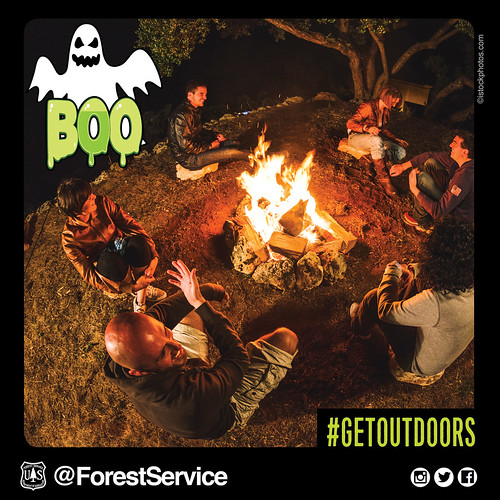
Ghost stories illustration by Mary Horning, US Forest Service.
Shadows start falling fast while you scurry to gather the last scraps of dead wood before it’s too dark – and too scary – to leave the relative security of the campsite on your favorite National Forest or Grassland. But, once the fire is safely lit, everyone gathers around to start roasting marshmallows and listen to…ghost stories!
No one really knows when or how the tradition of telling scary ghost stories around a campfire began. It just did, and we really like to do it. In fact, there are many books out there that provide those with less creative story telling talents to get a group of outdoors enthusiasts nervously shifting their eyes and jumping at the sound of what was certainly a twig being broken by the heavy foot of a monstrous creature in the night or, yes, even a clumsy ghost.
There are many reasons most of us, to some degree, are afraid of the dark especially while outside. Some believe it’s simply an evolved trait that kept us from, well, being eaten by the above mentioned monstrous creature in the night.
All I know is as a creative writer myself, I really looked forward to trying out my story telling skills around a campfire. Sometimes my spooky tales are really creative like the ghost of Isabella who haunted a nearby meadow searching for her child who wandered off and was never seen again.
And, sometimes, my stories are complete rip-offs from classics like Washington Irving’s headless horseman, albeit with a little twist. My headless dude was a lumberjack who literally lost his head in a bizarre tree cutting accident that really challenged my imagination to the delight of those around me.
But, bad, good or just silly—ghost stories that really scare you are best served around a campfire with friends and family. So start your summer this Great Outdoors Month and Get Outdoors with some really spooky and memorable fun!
Thursday, June 16, 2016
Knitting Together Treasured Landscapes with the Forest Legacy Program
From the #USDA:
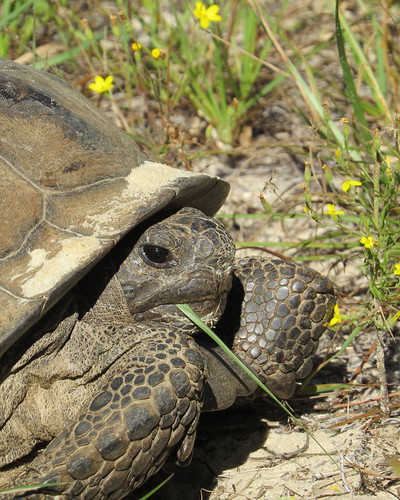
Gopher Tortoise. Photo by Dirk Stevenson of the Orianne Society.
Did you know the Forest Legacy Program is the only federal grant program focused on the permanent protection of important private forestland, conserving over 2.5 million acres to date?
This incentive-based and voluntary program managed by the U.S. Forest Service conserves working forests and environmental benefits for communities. It does this through land acquisition and conveyance to state management as well as through the establishment of conservation easements that allow families to maintain ownership of their land.
Forest Service researchers estimate that nearly 600,000 acres of forest are lost to development every year, with similar trends projected into the future. As demographic, commercial and climate change pressures intensify and threaten the integrity of some of the nation’s most treasured landscapes, the U.S. Forest Service has consistently supported efforts to assist and empower private landowners to conserve private lands.
One of these efforts is the Land and Water Conservation Fund (LWCF), which is funded through earnings from offshore oil and gas leasing royalties.
The LWCF expired last fall, but this Spring Congress reauthorized the fund with $450 million to continue this important work in coming years. With these and other funds, the Forest Service has been able to provide $100 million for 20 proposed projects across the country in 2017. These projects help families and communities preserve private forests while protecting and knitting together intact landscapes.
Selected projects are frequently championed by local communities that recognize the potential of this program to conserve not only the land and its resources, but the cultural identity that defines their landscapes.
One great example of what can happen when people utilize this program is the Lentile Longleaf Pine Tract in Georgia. This locally-driven work to protect a significant contiguous longleaf pine tract will secure the largest gopher tortoise tract in the state that includes over 1,800 acres of forested wetlands and cypress ponds, and provides the region with the many other benefits forests provide. Protected by land acquisition of over 7,000 acres of working forestland, the tract will buffer against imminent agricultural development that has fragmented wildlife habitat through much of the state.
Navajo and Hopi Expand the Community Collaborative Rain, Hail and Snow Network
From the #USDA:
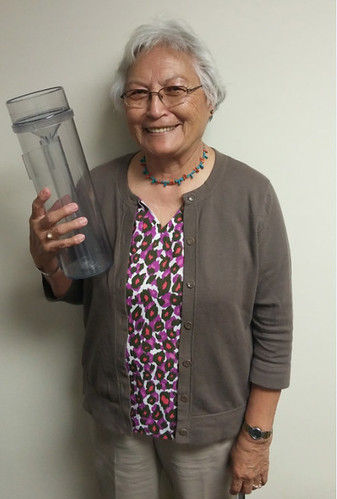
Susie Wauneka is a member of the Navajo Nation and has been an avid CoCoRaHS observer since December 2015.
Susie Wauneka has discovered a unique way to serve her community; by watching the weather. Wauneka is a proud member of Navajo Nation and is a Navajo Community Health Representative, providing critical health care services for members of the Nation. In December 2015, she discovered yet another way to serve—by using a Community Collaborative Rain, Hail and Snow (CoCoRaHS) precipitation gauge to track the amount of rain and snow that falls.
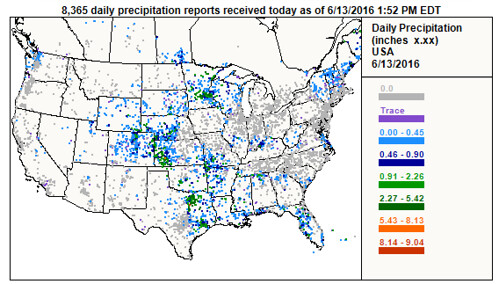
The CoCoRaHS network is a unique grassroots network of thousands of trained volunteers of all ages and backgrounds working together to improve meteorological science by measuring and reporting precipitation amounts (rain, hail, and snow). CoCoRaHS is the largest provider of daily precipitation observations in the United States. The data from these observations are used by USDA and theNational Oceanic and Atmospheric Administration (NOAA) for tools such as the United States Drought Monitor.
Like many weather-monitoring projects, CoCoRaHS was borne out of a disaster, the Spring Creek flood that struck Fort Collins, Colorado in July 1997, killing five people. In response to the flood, a team at the Colorado Climate Center at Colorado State University led by Nolan Doesken, developed a network of volunteer observers along the Colorado Front Range. During the 2000s, CoCoRaHS expanded beyond Colorado to become a national network, even reaching the White House that joined CoCoRaHS in 2015 using a gauge monitored by the National Park Service.
“Precipitation is our water supply,” said Nolan Doesken, State Climatologist for Colorado and the founder and director of CoCoRaHS. “What falls from the sky varies greatly from year to year and also from place to place even just a few miles apart. Volunteers do a fantastic job of helping track precipitation locally and nationally. The more volunteers who help out, the better we can track and appreciate this critical resource.”
In March 2016, President Obama issued a Presidential Memorandum on Drought which outlined six goals to better coordinate Federal support for drought-related efforts, help communities reduce the impact of current drought events, and prepare for future droughts. Goal One focuses on data collection and integration and outlines the need for the Federal government to better facilitate Citizen Science initiatives throughout the country. In carrying out this goal, USDA and NOAA have been working to expand the reach of CoCoRaHS gauges into the Southwest, a region typically data-sparse.
Recently, with funding from the Natural Resources Conservation Service, USDA purchased 72 CoCoRaHS gauges for Navajo and Hopi Tribal lands. The gauges were delivered by National Weather Service (NWS) Scientists to Navajo Nation chapter houses and to the 15 villages on the Hopi Reservation. NWS staff have begun to train volunteers to accurately report precipitation. Susie Wauneka is just one of the observers whose measurements now contribute to filling the data gap in the Southwest.
Through the expansion of the CoCoRaHS initiative, USDA and NOAA are engaging citizens in the process of collecting data and ultimately working to create more drought-resilient communities. Community and tribal leaders throughout the Southwest now have the opportunity to help our nation become more drought resilient through better data.
For more information or to become a CoCoRaHS observer please visit http://www.cocorahs.org/.
CoCoRaHS is the largest provider of daily precipitation observations in the United States.
Students Intrigued Enough to ‘Worm’ Their Way into Ag Science
From the #USDA:
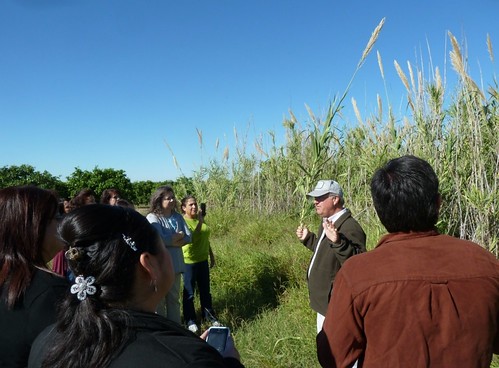
Future Scientists Program teachers in the field with ARS research entomologist John Goolsby, learning about his research on bio-control for Giant Reed (Arundo donax) in the Rio Grande Valley.
This post is part of the Science Tuesday feature series on the USDA blog. Check back each week as we showcase stories and news from USDA’s rich science and research portfolio.
The goal of USDA’s Hispanic-Serving Institutions National Program (HSINP) Future Scientists Program is to enhance the scientific knowledge of teachers, helping them to become more effective in encouraging student interest and progress in science. Teachers in the program attend two-day summer institutes at Agricultural Research Service (ARS) labs nationwide, where scientists introduce them to various research projects. ARS researchers share scientific knowledge with the teachers, who then share it with their students to encourage them to become future scientists.
One of the catalysts for this lofty goal is a tiny, inconspicuous and innocuous caterpillar—the corn earworm that wreaks havoc in corn fields nationwide as an agricultural pest. This program began in 2003. I brought 10 teachers into the ARS Southern Plains Agricultural Research Center (SPARC) in College Station, Texas, for a summer institute that included teachers studying in corn research plots searching for corn earworm caterpillars in 100-degree heat! It was the first time I made caterpillars the focus of this program.
Since then, the program has expanded to include students visiting various ARS research labs. I have also harnessed the caterpillar’s “intrigue factor,” since students are intrigued by insects. They are intrigued by the magic of metamorphosis—particularly when the caterpillar transforms into a beautiful moth. They are intrigued that they can learn by observation. They are intrigued enough to ask questions about the worm and then conduct research projects to find answers. The ARS Southeast Area insectary in Stoneville, Mississippi, generously supplies the program with all the worms we need.
Students conduct research on the worms and then make presentations at the end of their school year at their local ARS lab at a Future Scientists Student Research Presentation Day. They also take tours and learn about other research projects at the labs.
One student who presented in 2004 subsequently became a student summer worker at SPARC while in high school, continued working while studying entomology at junior college, and has just received a scholarship to attend Texas A&M University.
This year, his teacher brought four of her current fifth-graders to present their research on the worm. These are just four of the 86,000 students (grades K through 12) whom we have interacted with in the past 21 years of the Future Scientist Program. During that time, 5,600 teachers have studied Ag Science at 36 of the ARS labs nationwide.
Union Pacific Ascends Newsweek's 2016 Green Rankings
From Union Pacific:
Union Pacific Ascends Newsweek's 2016 Green Rankings
OMAHA, NEB., JUNE 13, 2016
Union Pacific Railroad climbed Newsweek's 2016 Green Rankings to No. 81 among U.S. businesses and No. 143 globally, improving from No.121 among U.S. businesses and No. 187 globally in 2015. The magazine recently ranked publicly traded companies by market capitalization.
"Union Pacific is honored to be recognized for its continued commitment to operating a safe, efficient and environmentally responsible railroad," said Scott Moore, Union Pacific senior vice president – Corporate Relations. "Being a good neighbor in the communities where our employees and customers live and work is of utmost importance."
Newsweek scores publicly traded companies against their global industry group peers based on eight indicators:
Union Pacific recently released its 2015 Building America Report, detailing key sustainability accomplishments such as becoming the safest Class 1 railroad in the United States based on its employee injury rate, and operating 100 locomotives that meet the Environmental Protection Agency's stringent Tier 4 emissions standards.
ABOUT UNION PACIFIC
Union Pacific Railroad is the principal operating company of Union Pacific Corporation (NYSE: UNP). One of America's most recognized companies, Union Pacific Railroad connects 23 states in the western two-thirds of the country by rail, providing a critical link in the global supply chain. From 2006-2015, Union Pacific invested approximately $33 billion in its network and operations to support America's transportation infrastructure. The railroad's diversified business mix includes Agricultural Products, Automotive, Chemicals, Coal, Industrial Products and Intermodal. Union Pacific serves many of the fastest-growing U.S. population centers, operates from all major West Coast and Gulf Coast ports to eastern gateways, connects with Canada's rail systems and is the only railroad serving all six major Mexico gateways. Union Pacific provides value to its roughly 10,000 customers by delivering products in a safe, reliable, fuel-efficient and environmentally responsible manner.
The statements and information contained in the news releases provided by Union Pacific speak only as of the date issued. Such information by its nature may become outdated, and investors should not assume that the statements and information contained in Union Pacific's news releases remain current after the date issued. Union Pacific makes no commitment, and disclaims any duty, to update any of this information.
Subscribe to:
Posts (Atom)