Watch as U.S. Senator Roger Wicker, R-Miss., speaks about his "Coastal Conservation Act" prior to a unanimous vote in favor of the legislation by the Senate Committee Commerce, Science, and Transportation.
#RogerWicker
Thursday, June 16, 2016

Thursday, June 9, 2016
The Nutrient Challenge of Sustainable Fertilizer Management
From the #USDA:
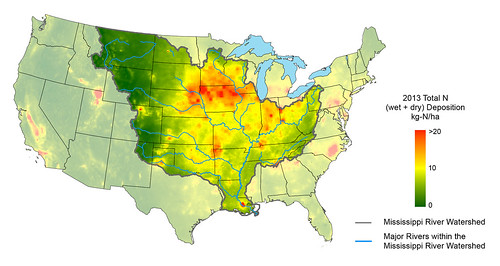
Map of nitrogen deposition in the United States.
This post is part of the Science Tuesday feature series on the USDA blog. Check back each week as we showcase stories and news from USDA’s rich science and research portfolio.
It’s a case of “darned if you do, darned if don’t.”
The global population is projected to reach 9.7 billion by 2050 and we will have to grow a lot more food to feed all of those people. Some might think we would need to use a lot more fertilizer; however, too much fertilizer—nitrogen and phosphorus—can be disastrous to ecosystems, affecting the water, land, air, and biodiversity. The nutrient challenge is to improve fertilizer efficiency to produce more food and energy crops while creating less pollution.
Each year farmers apply millions of tons of manufactured fertilizer, of which 40-80 percent is lost to the environment. Unfortunately, fertilizer run-off that ends up in lakes, rivers, and estruaries can lead to eutrophication, which is harmful to the ecosystem. Eutrophication is a process where fertilizer stimulates dense marine and fresh water plant growth, which can lead to the death of animal life due to lack of oxygen. Eutrophication is responsible for the 2014 algae bloom in Lake Erie that poisoned drinking water in Toledo, Ohio.
At sea, eutrophication may lead to dead zones; there are nearly 500 eutrophic and hypoxic (low oxygen) zones around the world, including 12 in the Chesapeake Bay. Excess fertilizer also plays a role in acidification and is linked to unhealthy bleached coral.
NIFA is working to monitor and mitigate the effects of excess fertilizer and prevent its occurrence in the first place. One example is NIFA support of the National Atmospheric Deposition Program, which tracks how airborne nitrogen is deposited in the United States and contributes to the dead zone in the Gulf of Mexico. The agency provides $500,000 in Hatch Act funding for state agricultural experiment station research and coordinates $1.8 million per year of interagency funding in support of the program
NIFA has also provided millions of dollars from various grant programs to support fertilizer-related research, education and extension projects. These efforts include improving the efficiency of fertilizers, promoting more effective use of fertilizers, mitigating and reducing strategies, and developing precision technology.
The fertilizer industry has recognized the problem. The U.S. Fertilizer Institute and the International Plant Nutrition Institute promotes the use of the “4Rs” as a management practice for farmers. The 4Rs include: right source/kind (match the fertilizer type to crop needs); right time (make nutrients available when the crop needs them); right rate (match the amount of fertilizer to crop needs); and the right place (keep nutrients where crops can use them).
Nitrogen use efficiency is quantifiable; the more efficient the uptake of nitrogen by the plant, the less escapes into the environment. Existing and future NIFA-supported research, coupled with the application of the 4Rs, will help solve the nutrient challenge.
NIFA invests in and advances agricultural research, education and extension and seeks to make transformative discoveries that solve societal challenges.
Tuesday, June 7, 2016
US Forest Service Waives Fees for National Get Outdoors Day – June 11
From the #USDA:


Forest Service employee, Michaela Hall, rafting on the Middle Fork of the Flathead River adjacent to Glacier National Park in Montana.
In an era of social media mania, forests around the country are opening their doors to reacquaint kids and parents with good old fashion family fun—without the aid of modern technology.
On Saturday, June 11, the U.S. Forest Service invites families to join thousands of forest explorers for a free, fun-packed day of outdoor adventures in celebration of National Get Outdoors Day.
The event also known as “GO Day” is celebrating its ninth anniversary of inspiring national and local organizations to come together to promote the social, economic and environmental benefits of outdoor recreation. Dozens of events on national forests and grasslands will feature opportunities including camping, rock wall climbing, kayaking, biking and archery.
Nationwide, more than 100 locations will provide free recreational and educational activities. Some events are specifically designed to better engage urban and multicultural youth in nature-based activities and attract first-time visitors to public lands.
In the spirit of GO Day, fees are waived generally for day-use areas, such as picnic grounds, developed trailheads and destination visitor centers. Concessionaire-operated sites may be included in the waiver if the permit holder wishes to participate. Contact your local national forest or grassland to learn if your destination requires a fee or if that fee is waived.
National forests provide tremendous settings for spending a day or two in the great outdoors. These public lands provide more than 158,000 miles of recreational trails, wild and scenic rivers, lakes and streams, thousands of campgrounds and day-use sites, and educational opportunities at Forest Service visitor centers. These lands also add more than $13 billion in benefits to local economies.
June is Great Outdoors Month, and U.S. Forest Service Chief Tom Tidwell of the Forest Service invites all Americans to join the Forest Service and its many partner organizations in getting out and exploring all types of recreational activities throughout the month.
GO Day is proud to support the First Lady’s Let’s Move Outside campaign to eliminate childhood obesity within one generation. The goal is to get kids active so they see the physical activity they need not as a chore, but as a fun way to explore our country.
The remaining fee-free days for 2016 include National Public Lands Day (Sept. 24) and Veterans Day weekend (Nov. 11-13).
Kids playing in a favorite lake.
Saturday, June 4, 2016
The Wonders of Wood Buildings
From the #USDA:
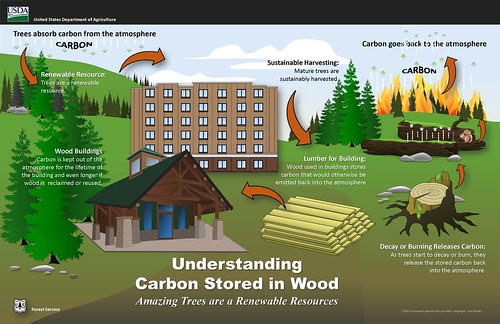
Forests and wood products are powerful tools to help mitigate the impacts of climate change. (Click to view a larger version)
Trees do plenty of work to sequester carbon on their own, but many forests are not as healthy as they should be due to fire suppression and climate change. This can leave trees vulnerable to large scale insect damage, fire or drought, and much of the carbon stored by forests is lost to the atmosphere as trees die.
The U.S. Forest Service is committed to the storage of carbon using wood products through the green building and wood products strategy. This strategy involves putting people to work in rural communities, enhancing resiliency of our ecosystems, and sequestering carbon by promoting the use of wood products in large building construction.
By using wood instead of, or along with, concrete and steel, large amounts of carbon can be stored in the walls of homes and offices, significantly reducing emissions associated with the production of other materials. Also, using sustainable timber harvests for emerging wood product technologies like cross-laminated timber, can stimulate local economies in timber country while sequestering carbon in long-term wood products.
Cross laminated timber is a wood panel made of layers of dried lumber boards stacked in alternating directions, glued and pressed to form solid panels. These panels have extraordinary strength and are being used as walls, roofs, and floors. D.R. Johnson Mill in Riddle, Oregon announced recently that it will be the first U.S. mill certified to produce cross-laminated timber for high rise construction.
Putting our own green building strategy to work, the Forest Service is working to increase the use of locally milled timber in all new agency buildings and facilities. Since 2011, we have used wood to build the Angeles National Forest Supervisor’s Office, Camino Real Ranger Station, Corvallis Laboratory, Juneau Laboratory, and Enomee Ranger District Office.
And in the private sector projects like the Bullitt Center in Seattle are showcasing the use of sustainable, Forest Stewardship Council certified wood products to efficiently create new buildings that will last and become testaments to sustainable forest management. The Bullitt Center sequesters 1,703 metric tons of carbon in its walls.
The trees in our national forests can help mitigate the effects of climate change in so many ways, and the Forest Service is committed to helping neighboring communities by promoting sustainable development with trees and wood.
Wednesday, June 1, 2016
Safer Operations, Community Impacts and Emissions Reduction Efforts Detailed in Union Pacific's 2015 Building America Report
From Union Pacific:
Safer Operations, Community Impacts and Emissions Reduction Efforts Detailed in Union Pacific's 2015 Building America Report
OMAHA, NEB., JUNE 1, 2016
Union Pacific Railroad highlights progress toward the company's safety, social, environmental and economic sustainability goals in its 2015 Building America Report.
"The Building America Report captures our commitment to operate a safe, efficient and environmentally responsible rail network and uses theGlobal Reporting Initiative's G4 Guidelines to outline our most relevant sustainability issues and opportunities," said Scott Moore, Union Pacific senior vice president - Corporate Relations. "It also illustrates our dedication to be a good neighbor that strengthens the communities where our employees live and work."
The Building America Report notes Union Pacific's key sustainability accomplishments in 2015, including:
This marks the seventh year Union Pacific reports its sustainability business practices and goals. More information about Union Pacific and access to the entire 2015 Building America Report are available at www.up.com.
ABOUT UNION PACIFIC
Union Pacific Railroad is the principal operating company of Union Pacific Corporation (NYSE: UNP). One of America's most recognized companies, Union Pacific Railroad connects 23 states in the western two-thirds of the country by rail, providing a critical link in the global supply chain. From 2006-2015, Union Pacific invested approximately $33 billion in its network and operations to support America's transportation infrastructure. The railroad's diversified business mix includes Agricultural Products, Automotive, Chemicals, Coal, Industrial Products and Intermodal. Union Pacific serves many of the fastest-growing U.S. population centers, operates from all major West Coast and Gulf Coast ports to eastern gateways, connects with Canada's rail systems and is the only railroad serving all six major Mexico gateways. Union Pacific provides value to its roughly 10,000 customers by delivering products in a safe, reliable, fuel-efficient and environmentally responsible manner.
The statements and information contained in the news releases provided by Union Pacific speak only as of the date issued. Such information by its nature may become outdated, and investors should not assume that the statements and information contained in Union Pacific's news releases remain current after the date issued. Union Pacific makes no commitment, and disclaims any duty, to update any of this information.
Climate Hubs Help APHIS Adapt to Climate Change
From the #USDA:
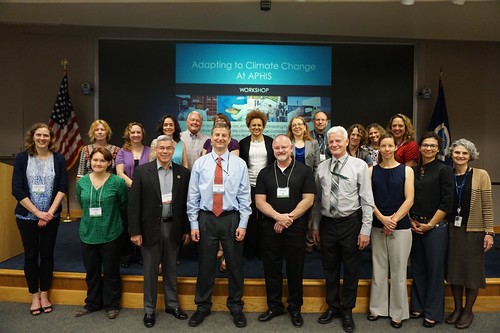
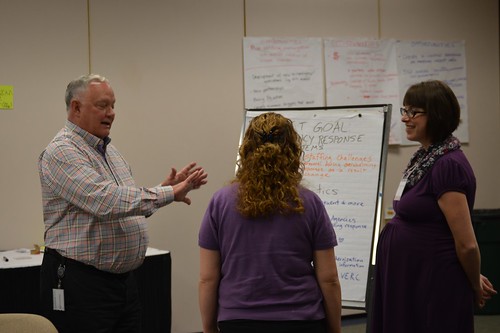

Participants in the climate change adaptation workshop. Photo credit: Joseph Vorgetts
All this month we will be taking a look at what a changing climate means to Agriculture. The ten regional USDA Climate Hubs were established to synthesize and translate climate science and research into easily understood products and tools that land managers can use to make climate-informed decisions. The Hubs work at the regional level with an extensive network of trusted USDA agency partners, technical service providers, University collaborators, and private sector advisers to ensure they have the information they need to respond to producers that are dealing with the effects of a variable climate. USDA’s Climate Hubs are part of our broad commitment to developing the next generation of climate solutions, so that our agricultural leaders have the modern technologies and tools they need to adapt and succeed in the face of a changing climate.
How important will climate change considerations be in your work in the next 3-5 years? That was one of the questions USDA employees were asked in mid-April at the start of a two-day workshop at the Animal and Plant Health Inspection Service (APHIS) in Riverdale, Maryland. The hands-on training session, facilitated by APHIS’ Climate Change Working Group, the Forest Service, Northern Forests Climate Hub and the Northern Institute of Applied Climate Science, was designed to help APHIS employees from various program and support units incorporate climate change considerations into their actual projects.
The workshop emphasizes a structured yet flexible adaptation approach developed by the Forest Service to integrate climate change considerations into project planning and activities. The five-step process includes 1) defining the area of interest, 2) assessing climate change impacts, 3) evaluating management objectives, 4) identifying and implementing adaptation tactics, and 5) monitoring and evaluating the effectiveness of the actions.
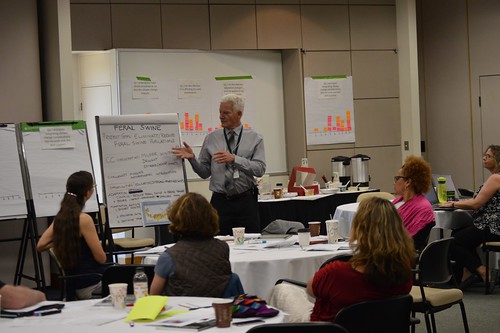
APHIS’ Thomas Hall leads a group discussion about climate change and feral swine management. Photo credit: John Scott
Workshop participants used this process to analyze how climate variability and uncertainty and shifting geography might affect APHIS’ mission in addressing the presence and movement of agricultural pests and diseases. For instance, would exotic animal and plant species—already proven to be adaptable to changing conditions—be better equipped than native species to survive climate change? How might storm surges aid in the spread of wood-borne pests? How might certain changes in climate in other countries affect shipping routes, import seasons, and other trade issues?
The workshop challenged participants to consider new approaches to adapting to climate change. A majority predicted they would apply the adaptation workbook process to another project in the next year. Nearly every respondent said they would share what they had learned with people inside andoutside the agency.
APHIS’ Richard Walker discusses the possible effects of climate change on emergency management response, with APHIS’ Denise Sylvester (center, an investigation and compliance specialist) and Danielle Shannon (right, USDA Northern Forests Climate Hub coordinator). Photo credit: John Scott
As to the question about how likely climate change considerations would be in their work in the next 3-5 years? On a scale of 1-10, workshop participants, on average, rated that an 8.
Like the climate, the times, they are a-changing too.
APHIS’ Marlene Cole records a group’s brainstorming efforts regarding climate change on feral swine management. Photo credit: John Scott
Climate Data Tools for Informed Decisions
From the #USDA:
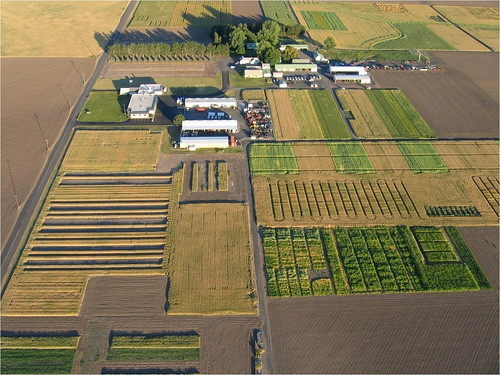
Aerial view of GRACEnet test plots at the Columbia Plateau Conservation Research Center in Pendleton, Oregon. Photo by Oregon State University.
This post is part of the Science Tuesday feature series on the USDA blog. Check back each week as we showcase stories and news from USDA’s rich science and research portfolio.
Responding to Climate Variability is one of the goal areas of the REE Action Plan. The objective is to develop science-based knowledge to address climate variability, position agricultural communities to reduce emissions of greenhouse gases, and enhance carbon sequestration.
Many valuable USDA accomplishments for the year 2015 were the result of cross-divisional teams that developed useful tools to support decision-makers with research-based data. Knowing weather and climate patterns–driving forces behind the success or failure of cropping systems–is vital information to land managers. One such tool, AgroClimate, supported by REE and the National Oceanic and Atmospheric Administration (NOAA), helps users manage climate risk with tools that provide information on crops best suited to grow in their region, based on water availability and the amount of water a crop will use.
Useful to Usable (U2U) is an integrated research and extension project funded by the REE working to improve farm resilience and profitability in the North Central United States by transforming existing climate data into usable products for the agricultural community. The goal is to help producers make better long-term plans on what, when, and where to plant, and how to manage crops for maximum yields and minimum environmental damage.
Understanding the impact of climate change on agricultural production and food security is crucial to help feed, clothe, and fuel a growing world population. REE joined with multiple institutions to model the economic responses of global agriculture to scenarios of climate change through 2050, including changes in harvested area, international trade, production, consumption, and price. All scenarios modeled show the potential for significant increases in prices for food and agricultural commodities, raising important concerns about food security, particularly for poor households.
Ensuring nutritional security and supplying the calories for an ever-growing population presents a major challenge because of a combination of factors. REE has formed transdisciplinary teams to enable agriculture to adapt to a changing climate through the Genetics by Environment by Management (GxExM) approach, seeking to increase actual farmer yields rather than increasing potential yields offered by crop genetic potential.
Under the heading of GRACEnet – Greenhouse gas Reduction through Agricultural Carbon Enhancement Network, REE scientists are generating information that is needed by producers, program managers, and policymakers concerning carbon storage in agricultural systems. The goal is to develop practices that enhance carbon sequestration in soils and to provide a sound scientific basis for carbon credits and trading programs.
These achievements represent just a sample of the accomplishments across the Department in the effort to respond to changes in the climate. USDA’s research, education, and extension programs provide the knowledge necessary to adapt agricultural and forestry production practices appropriate to changing climate and to ensure knowledge researches our many partners and the public.
Subscribe to:
Posts (Atom)