Search This Blog

Thursday, September 29, 2016

EPA Finalizes $15 Million Additional Cleanup at former Pesticides Plant in Vineland, N.J.

From the EPA:


EPA Finalizes $15 Million Additional Cleanup at former Pesticides Plant in
Vineland, N.J.
Contact: Elias Rodriguez, (212) 637-3664), rodriguez.elias@epa.gov
(New York, N.Y. – Sept. 28, 2016) The U.S. Environmental Protection Agency has finalized modifications to its plan to clean up contaminated exposed sediment in the Blackwater Branch floodplain at the Vineland Chemical Company Superfund site in Vineland, N.J. As a result of previous operations by the chemical company at the site, the groundwater, soil and sediment are contaminated with arsenic. Arsenic is known to cause cancer, as well as many other serious health problems. The EPA dredged, excavated and disposed of arsenic-contaminated sediment from the site according to its original cleanup plan. The EPA will modify the cleanup by adding treatment technologies to address areas in the Blackwater Branch floodplain that became re-contaminated with arsenic since those activities were completed.
Drinking water in the area is supplied by a public drinking water provider and is regularly tested to ensure that it meets all state and federal standards.
“The Vineland Chemical Company manufactured arsenic-based herbicides at this property in Vineland and left a toxic legacy,” said EPA Regional Administrator Judith A. Enck. “We have come a long way in cleaning up this site, which was seriously contaminated with toxic arsenic that polluted the area.”
The Vineland Chemical Company site is located at 1405 North Mill Road in Vineland, N.J. Arsenic-based herbicides were manufactured at a facility located at the 26-acre area from 1949 to 1994. Due to the company’s poor handling, storage and disposal of byproduct arsenic salts, soil, groundwater and the nearby Blackwater Branch, Maurice River and Union Lake have been contaminated with arsenic from the site.
The EPA has addressed contamination at the Vineland site in several stages: immediate actions, and four long-term cleanup phases focused on controlling the source of the contamination, addressing or reducing the spread of the groundwater contamination, cleaning up the marsh and river areas, and cleanup of the downstream lake. 
Work began on the site in 1992. The EPA first fenced off the contaminated areas, removed hazardous chemicals stored on the site, and demolished all abandoned buildings on the site. To address the arsenic-contaminated soil, the EPA constructed a soil washing facility. To address contaminated groundwater, the EPA constructed a system to pump out and treat approximately two million gallons a day of contaminated groundwater. The pump and treat system was also used to prevent the arsenic contaminated groundwater from spreading into the Blackwater Branch. To address contaminated sediments in the Blackwater Branch and Maurice River, the EPA excavated and treated sediments in the soil washing facility.  After backfilling the area with clean soil, the stream channel and floodplain were restored, but the EPA has found that even with the pump and treat system in place, soil and sediment in the Blackwater Branch is becoming re-contaminated with arsenic. 
In order to address the exposed sediment and soil of the Blackwater Branch, the EPA is amending the cleanup by treating the arsenic in the groundwater in order to prevent recontamination of the exposed sediment. For instance, the EPA may use a technology called air sparging to reduce the contamination in the groundwater.  Oxygen injected into the ground through air sparging reacts with arsenic, making it immobile and insoluble. The specific treatment or treatments will be selected after the EPA further studies the conditions in localized areas to gauge the effectiveness.
The EPA may also require excavation of “hot spots” to remove remaining contaminated exposed sediment or soil in the Blackwater Branch floodplain. Throughout the cleanup, monitoring, testing and further studies will be conducted to ensure the effectiveness of the remedy and protection of the environment. The cleanup under this plan is estimated to cost $15 million.
The EPA will continue to monitor the Maurice River and a plan to cleanup Union Lake will be will be finalized once the upstream sources of contamination have been stopped.
The Superfund program operates on the principle that polluters should pay for the cleanups, rather than passing the costs to taxpayers. The EPA searches for parties legally responsible for the contamination at sites that are placed on the Superfund list and it seeks to hold those parties accountable for the costs of investigations and cleanups. In 1994, the EPA reached a settlement with Vineland Chemical Company and the owners of the site, which paid for a portion of the cleanup. Other cleanup costs have been funded with taxpayer dollars, including through the 2009 American Recovery and Reinvestment Act.
The EPA held a public meeting in Vineland on August 8, 2016 to explain its plan. The EPA accepted public comments for 30 days and considered public input before finalizing the plan.
To view the modified cleanup plan, please visit: www.epa.gov/superfund/vineland-chemical
To view a direct link to the cleanup plan, please visit:  https://semspub.epa.gov/src/document/02/393184
            16-090

EPA’s SmartWay Honors Union Pacific Distribution Services as Green Leader in the Freight Industry

From EPA Region 7:


FOR IMMEDIATE RELEASE
 
U.S. Environmental Protection Agency, Region 7
11201 Renner Blvd., Lenexa, Kansas 66219
 
Iowa, Kansas, Missouri, Nebraska, and Nine Tribal Nations
 
EPA’s SmartWay Honors Union Pacific Distribution Services as Green Leader in the Freight Industry
 
Contact Information: Christie St. Clair (News Media Only), stclair.christie@epa.gov, (202) 564-2880
 
Environmental News
 
FOR IMMEDIATE RELEASE
 
LENEXA, Kan. (Sept. 28, 2016) - Union Pacific Distribution Services, of Omaha, Neb., is one of nine companies in the United State to receive U.S. Environmental Protection Agency SmartWay® Excellence Awards, honoring logistic companies and shippers in the retail and manufacturing sectors.
 
The awards recognize the top-performing SmartWay shipper partners that demonstrate how businesses can mitigate their carbon footprints and contribute to cleaner, healthier air, while saving on fuel costs as they move goods across America.
 
“EPA is honoring its top environmental performers – those SmartWay Partners that have taken significant steps towards a sustainable freight transportation energy future,” said Christopher Grundler, director of EPA’s Office of Transportation and Air Quality. “SmartWay Excellence Award recipients have become leaders in this crucial sector of our economy by embracing the mutual benefits that efficiency brings for both operational performance and environmental results.”
 
The awards were presented today at the 2016 Annual Council of Supply Chain Management Professionals conference in Orlando, Florida. Other 2016 SmartWay Excellence Awardees for retailers, manufactures and logistics companies are:
 
  • Bacardi USA, Inc. (Coral Gables, Fla.)
  • Hewlett-Packard Inc.
  • Johnson & Johnson (Skillman, N.J.)
  • Kimberly-Clark Corporation (Knoxville, Tenn.)
  • Lowe's Companies Inc. (Wilkesboro, N.C.)
  • The Home Depot U.S.A. Inc. (Atlanta, Ga.)
  • Transportation Insight LLC (Hickory, N.C.)
  • Whirlpool Corporation (Benton Harbor, Mich.)
 
Award winners demonstrate a commitment to environmental leadership by achieving lower emissions and by demonstrating effective collaboration, advanced technology and operational practices, robust SmartWay data validation and reporting, communication and public outreach, and implementation of sustainability practices in local communities.
 
EPA’s SmartWay Transport Partnership supports companies who demonstrate their commitment to corporate sustainability and social responsibility by moving goods in the cleanest, most energy-efficient way possible. Since 2004, SmartWay Partners have avoided emitting more than 72 million metric tons of the carbon pollution that contributes to climate change, while saving more than 170 million barrels of oil and $24.9 billion in fuel costs – equivalent to eliminating annual energy use in more than six million homes. SmartWay also contributes to cleaner air and healthier citizens by significantly reducing emissions of the pollution that contributes to smog, including fine particulate matter and nitrogen oxides.
 
Awards for SmartWay carrier partners – such as trucking companies, multimodal transport companies and barge transport companies – will be announced next week at the 2016 American Trucking Association Management Conference and Exhibition in Las Vegas, Nevada.
 
# # #

Fall at Denali National Park and Preserve in Alaska

From U.S. Department of the Interior:


Fall at Denali National Park and Preserve in Alaska means gorgeous autumn colors and hungry brown bears. To get ready their long winter sleep, bears spend the summer and fall packing on the pounds -- gorging themselves on salmon, berries and grass. Sleeping snugly in their dens, breathing only once a minute and dropping their heart rate to 8-10 beats a minute, bears will live on their fat stores during the dark, cold winter. Photo by Jacob W. Frank, National Park Service. — at Denali National Park and Preserve.

Wednesday, September 28, 2016

Uranium and the Food Web

From U.S. Geological Survey (USGS):


Ask someone about the risk from uranium, and the answer you usually get is radiation. But there is another risk to aquatic life, and that’s the ability of uranium to enter the food web. USGS scientists recently completed a lab study on freshwater snails to see if dissolved uranium could enter the snail’s systems.

They found that it could, and that various factors like the pH of the water, the presence of dissolved organic matter, or the amounts of dissolved calcium or magnesium could affect how much uranium was taken in by the snails.

Read more about the study here:http://on.doi.gov/2d1MTf1

Image caption: Image shows a freshwater snail against a black background. Credit: Javier Garcia-Alonso, USGS. #USGS #science #Toxicology#Uranium

Rusty Patched Bumble Bee

From USFWS Southeast Region:


The rusty patched bumble bee, like all bumble#bees, is an important #pollinator of plants and wildlflowers. In fact, even where crops can be self-pollinated, the plant produces more and bigger fruits when pollinated by a bumble bee!

Unfortunately, there has been a steep decline in this bumblee bee’s range. Once widespread, the species is now found in scattered, small populations in 12 states and one Canadian province. We’re proposing to list this the rusty patchh bumblee bee as endangered species.

Learn more about this pollinator and how to provide comments: http://bit.ly/2d7JM4E

(Photo: Dan Mullen, Creative Commons)

New Research Provides Insights into Sage Grouse DNA


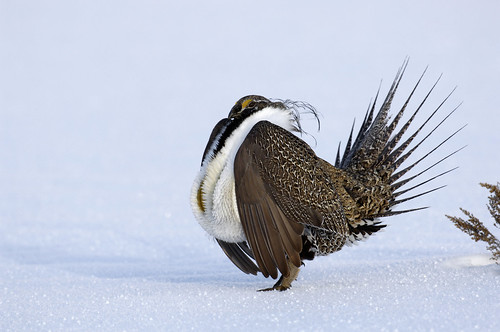
Sage grouse male
Sage grouse male strutting hoping to attract females.
The greater sage grouse is an iconic bird that lives in the American West’s sagebrush landscape. It’s also a species at the center of a nationwide debate focused on how best to manage its habitat to balance multiple uses and ensure the bird’s long-term survival.
And the dialogue has just been informed by new information from a genetics study that has validated the primary target locations of current conservation efforts.
Though sage grouse were once numerous, their populations have dwindled drastically from historic numbers. Their range is still impressively large, though. Sage grouse are spread across a staggering 258,000 square miles.
Since the remaining population inhabits such a vast landscape, partners working to conserve the sagebrush ecosystem focus efforts within Priority Areas for Conservation or PACs, which represent the habitat most critical for maintaining sage grouse populations. Understanding the population structure and genetic diversity within the species is also important for guiding ongoing conservation and restoration efforts.
new study found that the genetic subpopulations of sage grouse are synonymous with the existing management boundary of the PACs. This is important because validating the biological relevance of the existing PACs helps land managers plan conservation projects to more effectively manage sage grouse.
Todd Cross, a wildlife biologist with the University of Montana and U.S. Forest Service Rocky Mountain Research Station, worked with partners from the U.S. Forest Service, the Bureau of Land Management, states, and the NRCS-led Sage Grouse Initiative.
“We were thrilled to discover that existing management boundaries agree with genetic population structure,” said Cross. “It was a privilege to work with great minds from many backgrounds. We were able to combine expertise in wildlife management, landscape ecology, and genetics through this fantastic science partnership.”
Results show five subpopulations that occupy significantly different elevations and are surrounded by different dominant subspecies of sagebrush.
“The state agencies we work alongside had great foresight in creating these priority areas for conservation, and we hope that our results can help inform their continued efforts in conservation planning and sage grouse management,” Cross added.
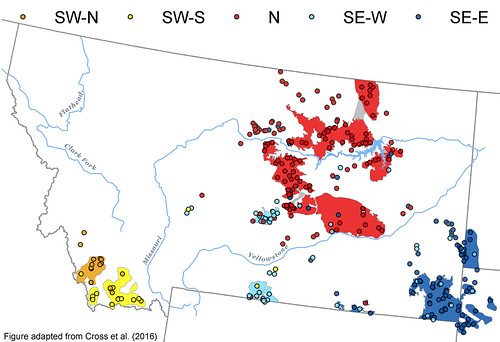
A sage grouse subpopulation map
Five greater sage grouse subpopulations exist across Montana, North Dakota and South Dakota. Individual grouse (points) are colored by population membership. The sixteen priority areas for conservation (polygons) sampled are colored according to proposed management groups that reflect genetic substructure.

Tuesday, September 27, 2016

SVCV

From U.S. Geological Survey (USGS):


Newt news: USGS scientists recently identified a deadly fish disease, called spring viraemia of carp virus (SVCV), in #salamanders. Read more athttp://on.doi.gov/2cIHKss.

Amphibians, the big-eyed, swimming-crawling-jumping-climbing group of water and land animals that includes frogs, toads and salamanders, are the most endangered vertebrates in the world. #SVCVwas identified in Chinese firebell#newts, a type of salamander, which were imported to the United States through the international pet trade.

This critical discovery marks the first time that SVCV has been detected in a group of animals other than fish, and may present a further threat to already-declining global populations of #amphibians.

Learn more about USGS wildlife disease research at http://on.doi.gov/JABDp9.

Image: A Chinese firebelly newt (Jeff Lorch, USGS)

#science #WildlifeDiseases