Wednesday, August 24, 2016

Measuring Hazelnuts in Oregon
From the USDA:
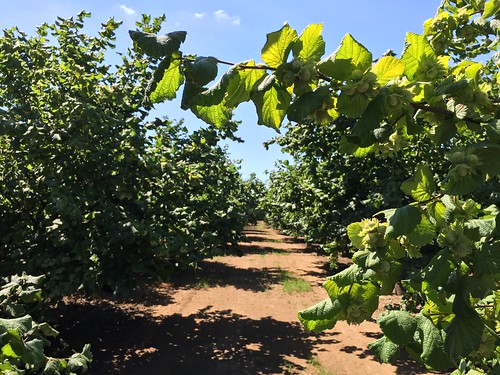
This is the oldest Yamhill variety hazelnut orchard in the State of Oregon. Yamhill is a newer, disease resistant variety developed by Oregon State University. The orchard is owned by Birkemeier Farms of Canby, OR.
Few realize that Oregon produces 99 percent of the hazelnuts in the United States. That means that an accurate forecast of hazelnut production in the Beaver state assists the industry in determining marketing plans and price. To do that, USDA’s National Agricultural Statistics Service runs a joint project with the Hazelnut Marketing Board of Oregon, which allows us to measure the most accurate production yields and forecasts for hazelnut production possible. This project is called the Oregon Hazelnut Objective Yield Survey.
When it comes to forecasting production of a particular commodity, there are various methods we can use. Predominantly we survey growers to get their estimate of their own farm production. We combine the farmers’ responses with objective yield measurements. In brief, we use the objective yield survey to count and measure the crop prior to harvest so that we can see what kind of crop we can truly expect by the end of the growing season.
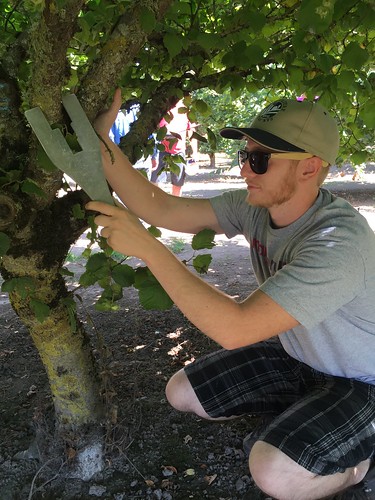
To conduct the Oregon Hazelnut Objective Yield Survey, we randomly select hazelnut orchards that represent the bearing acreage within Oregon. Factors we keep track of include the age of trees and variety. Once an orchard is selected and the producer grants permission to enter an orchard, the National Association of State Departments of Agriculture (NASDA) enumerators randomly select trees and branches from which to pick the nuts and send them to our laboratory for processing.
Enumerator Brandon Jordan measuring a branch during the branch selection process.
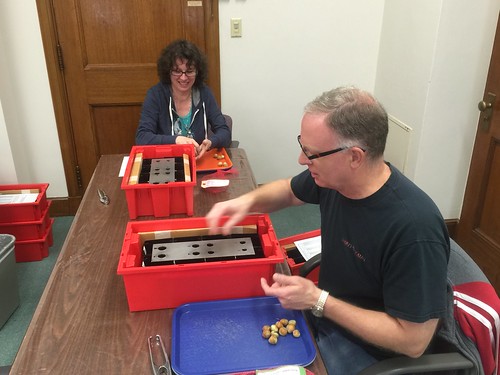
Once in the lab, nuts are counted and samples are selected to peel off the husk. We then measure the size of the nut and crack it open to determine if a kernel is inside the shell. All results are entered in a computer and summarized. That sounds simple but careful steps are taken along the way to ensure all documented procedures are followed consistently. The objective yield analysis helps ground-truth the survey and builds an accurate picture of the upcoming harvest.
Pest and weather impacts have made this work more challenging in recent years, yet by following consistent procedures our results provide solid, objective statistics that those interested in hazelnut production can rely on.
We conduct all these measurements from 180 different orchards during the first two weeks of August. Since the results have such a strong impact on the hazelnut industry, we make sure the data are published as soon as possible. The culmination of all these efforts was the report for 2016, in which we forecast Oregon hazelnut production for 2016 to be 38,000 tons. If realized, this will be a 23 percent increase from the 31,000 tons produced last year and above the five-year average of 37,200 tons.
Lab Supervisor Tim Zielke and Enumerator Stephanie Zielke place hazelnuts in a sizing grid to determine the size of the nuts.
Common Nighthawk
From U.S. Fish and Wildlife Service Midwest Region:

Common nighthawks will start migrating with the cooler nights of late August and early September. These long-distance travelers move in large flocks at all hours of the day, all the way to their wintering grounds in South America.
Photo: Common nighthawk courtesy of Brian Garrett/Creative Commons.https://flic.kr/p/bWqSGm

Common nighthawks will start migrating with the cooler nights of late August and early September. These long-distance travelers move in large flocks at all hours of the day, all the way to their wintering grounds in South America.
Photo: Common nighthawk courtesy of Brian Garrett/Creative Commons.https://flic.kr/p/bWqSGm
Black and Yellow Garden Spiders
From U.S. Fish and Wildlife Service Midwest Region:

Black and yellow garden spiders build circular webs that can be as large as 2 feet. Once prey gets stuck, they inject it with venom and wrap it up for later consumption. Their venom is harmless to humans.
Photo: Garden spider courtesy of Joel Tonyan/Creative Commons. https://flic.kr/p/fqAk8H

Black and yellow garden spiders build circular webs that can be as large as 2 feet. Once prey gets stuck, they inject it with venom and wrap it up for later consumption. Their venom is harmless to humans.
Photo: Garden spider courtesy of Joel Tonyan/Creative Commons. https://flic.kr/p/fqAk8H
Tuesday, August 23, 2016
Military Experience Opens Door for Soldier to Return to the Farm
From the USDA:
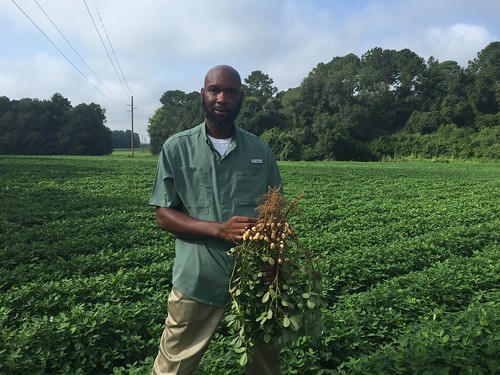
Veteran Tracy Robinson’s military experience counted toward farming experience, allowing him to access USDA microloan funding.
Graduating from high school in the small town of Blakely, Georgia, Tracy Robinson was required to take an armed forces aptitude test. When asked what he wanted to do with his life, Robinson said he wanted to farm. The Marine recruiter told him he would be a great field artilleryman.
“I heard the word field and thought it had something to do with farming,” said Robinson. He enlisted in the U.S. Marine Corps and after finding out field artillery had nothing to do with farming he stayed and fought for his country for 24 years, serving in Desert Shield, Afghanistan and Iraq.
He achieved the highest enlisted rank of E9 and traveled to 30 different countries before retiring in 2010 and returning to Georgia to do what he loves – farm.
Today, Robinson farms 300 acres of peanuts, cotton, soybeans and wheat, and he does it without owning or leasing any equipment. But to get to that point was a struggle and required a lot of support that many military veterans or underserved farmers once did not have.
Over the past eight years, however, the U.S. Department of Agriculture (USDA) has been turning that around, expanding the availability of its programs to more diverse farming communities, including veteran and women farmers. By forming partnerships and developing outreach efforts to restore trust and improve relationships, USDA has seen a 12 percent increase in black farmers and a 21 percent increase in Hispanic farmers.
The same efforts have been put into helping soldiers returning home who want to farm. Since 2009, USDA has provided $443 million in farm loans to help more than 6,505 veterans purchase farmland, buy equipment and make repairs and upgrades to farm businesses.
Robinson was one of those veterans who obtained a microloan in 2013 when, at the time, the Farm Service Agency (FSA) had just launched the $35,000 loan and shorter application process to help small and beginning farmers get started.
“Once I returned home from the military, I was able to rent the same land that my family rented farmed when I was a child,” said Robinson. “When I approached FSA in 2011 about a loan, they said I didn’t qualify because I had no farming experience.” He later ran into a high school friend who allowed him to volunteer and work on his farm to get the experience. “When the microloan came out, the criteria changed and my military experience counted toward my farming experience and I was approved.”
But the friendship and volunteering never stopped. Robinson still helps his friend while farming his own land; however, he enjoys the benefits because his friend allows him to use the farming equipment in return for Robinson’s help.
“Mr. Robinson is very successful primarily due to his discipline and attention to detail that can be attributed to his military experience. Also, his record keeping is unlike any other farmer that we work with,” said Rodney Brooks, former Farm Loan Officer with the Georgia FSA who helped Robinson at that time. “Without the microloan he would have had to struggle to fund his operation. Yet, Robinson insists that his situation is different from other veterans and underserved farmers.
“I do this because I enjoy farming and it is great mental and physical therapy for me,” said Robinson. “I had a lot of help. But a lot of military veterans return home to families and they don’t have the financial capital or access to get into farming.”
Robinson hopes to someday develop a program for veterans and young people, to not only teach them to farm, but teach leadership and life skills.
To learn more about how USDA is helping military veterans enter farming as a profession, visitwww.usda.gov/veterans and www.usda.gov/newfarmers. To learn more about FSA microloans, visitwww.fsa.usda.gov/microloans or contact your local FSA county office. You can find your nearest FSA office by visiting http://offices.usda.gov.
Citizen Science is Sound Science Provided by You
From the USDA:
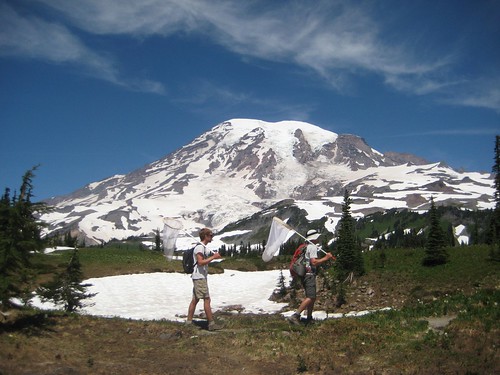
Volunteers traversing the North Cascades Mountains looking to track butterflies. Photo credit: National Park Service
Have you ever seen a cool bird in your backyard and wondered if there was some way to share what you saw with others? Better yet, have you thought about sharing your observations and having them used to help study and conserve those birds? These thoughts are an indicator that you might have the makings of a great citizen scientist!
The Forest Service is engaged in a wide variety of citizen science projects that encourage public involvement in natural and cultural resource science and conservation. Volunteers can contribute by forming research questions, collecting and analyzing data, or interpreting results. If you have a sense of wonder and discovery, citizen science may be for you.
Citizen science can help in conservation and protecting natural resources in two ways: increasing scientific knowledge just like conventional research; and creating a conversation about scientific information and policy and to encourage public input and action.
Many scientific projects would be difficult to research without the help of volunteers because of their size, complexity, or cost. Volunteers can contribute in many ways including helping to track patterns in space and time of one or more parts of the ecosystem, or in the discovery of species or importantcultural resources. At the same time, getting local communities engaged in projects can increase the relevancy of scientific research locally and can foster environmental stewardship. It can also build a better understanding between the community, scientists and decision makers about social aspects in environmental issues.
Many organizations rely on the best available science in order to make management decisions. However, the best scientific information does not necessarily come from peer-reviewed scientific publications, rather it is the best scientific information available to answer the questions raised.
Data integrity is achieved in the same way that it is in any research project, through standardized sampling procedures. Similar quality assurance and controls are used for both citizen science and conventional science and include training, collection of duplicate samples, and post-data collection analyses.
Your involvement matters.
The Forest Service very much wants to engage communities in caring for their land and natural resources. Every year, tens of thousands of volunteers take to the forests, grasslands, wetlands, coasts–and their own backyards–to contribute high quality data for science.
When the public is involved in land and resource management through citizen science, it can foster the connection between scientific discovery and public interest. So, how will you contribute to the places you love?
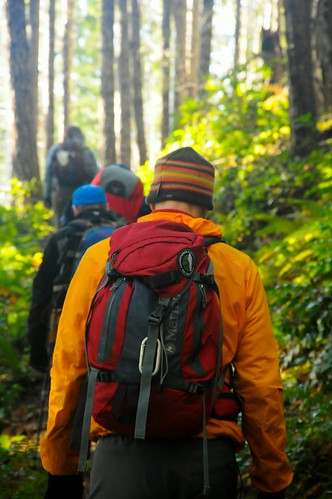
Volunteers walking the Olympic National Forest to monitor coastal martens. Photo credit: Adventurers and Scientists for Conservation
Subscribe to:
Posts (Atom)