Search This Blog

Sunday, May 22, 2016

EPA Brownfields Grants Will Aid Environmental Assessment and Cleanup in Two Alaska Communities

From EPA:


EPA Brownfields Grants Will Aid Environmental Assessment and Cleanup in Two Alaska Communities 
 
Contact Information: Judy Smith, Press Officer, 503-326-6994; smith.judy@epa.gov
                                 Susan Morales, Brownfields Program 206-553-7299; morales.susan@epa.gov
(Seattle – May 20, 2016) The Cook Inlet Housing Authority and the Matanuska-Susitna Borough in Alaska have been selected to receive Brownfields grants totaling $750,000 from EPA to help assess and cleanup contamination in their communities. Assistance provided by this program supports local efforts and serves areas that are underserved and economically disadvantaged, including neighborhoods where environmental cleanup and new jobs are most needed.  
The Matanuska-Susitna Borough in partnership the Cities of Palmer and Wasilla has been selected for $550,000 in brownfield assessment coalition grants. The $275,000 community-wide hazardous substances grant funds will be used to inventory and prioritize brownfield sites; conduct up to 12 environmental site assessments; and prepare three cleanup plans. Grant funds also will be used to prepare area-wide plans for two focus areas and conduct community outreach activities. The $275,000 petroleum grant funds will be used to conduct the same tasks at sites with potential petroleum contamination.
The Cook Inlet Housing Authority in Anchorage has been selected for a $200,000 petroleum cleanup grant. The petroleum grant funds will be used to clean up the Tesoro-Olson Site/Alpina Auto Repair Shop site at 3607 and 3609 Spenard Road in Anchorage. The site has been used as a gas station since 1964 and as an auto repair facility, car wash and detail shop, wood lot, and rental car business since the mid-1990s. It is contaminated with petroleum hydrocarbons.
“We support the vision of the Matanuska-Susitna Borough and Cook Inlet Housing Authority as they work locally to bring new life to these underutilized properties,” said Sheryl Bilbrey, Director of EPA Region 10 Office of Environmental Cleanup.  “We are pleased that the EPA Brownfields grant funding will help leverage additional partners and resources to help make a visible difference in these communities.”
These grants are part of part of 218 national grant investments totaling $55.2 million that is being provided to 131 communities across the nation.  
Read the fact sheets about the Matanuska-Susitna Borough and Cook Inlet Housing Authority proposals at: https://cfpub.epa.gov/bf_factsheets/
For more information on Brownfields grants: https://www.epa.gov/brownfields/types-brownfields-grant-funding
Read the national announcement listing all 218 grant investments at: National Brownfields ARC Grant Announcement

###

EPA Brownfields Grants Will Aid Environmental Assessment and Cleanup in Three Oregon Communities

From EPA:


EPA Brownfields Grants Will Aid Environmental Assessment and Cleanup in Three Oregon Communities 
 
Contact Information:  Judy Smith, Press Officer, 503-326-6994; smith.judy@epa.gov
                                  Susan Morales, Brownfields Program 206-553-7299; morales.susan@epa.gov
(Seattle – May 20, 2016) The Tigard City Center Development Agency, Metro Clackamas County and the City of Portland in Oregon have been selected to receive Brownfields grants totaling $1.4 million from EPA to help assess and cleanup contamination in their communities. Assistance provided by this program supports local efforts and serves areas that are underserved and economically disadvantaged, including neighborhoods where environmental cleanup and new jobs are most needed.  
The Tigard City Center Development Agency has been selected for two hazardous substances brownfields cleanup grants totaling $400,000.  The grant funding will be used to clean up two properties that are contaminated with halogenated volatile organic compounds, metals, and polychlorinated biphenyls.  The properties being cleaned up are located at the Main Street/Fanno Creek (Saxony-Pacific) site at 12533 and 12535 SW Main Street, the former site of a sawmill, welding shop, and printing shop. Grant funds at both properties also will be used to enforce institutional controls and conduct community engagement activities.
The City of Portland has been selected for two brownfields assessment grants totaling $400,000. Community-wide hazardous substances grant funds will be used to conduct four environmental site assessments and prepare two cleanup plans. Grant funds also will be used to support community outreach activities. Community-wide petroleum grant funds will be used to conduct the same tasks at sites with potential petroleum contamination.
Metro in partnership with Clackamas County and the City of Oregon City has been selected for two brownfields assessment grants totaling $600,000. Community-wide hazardous substances grant funds of $300,000 will be used to update an inventory of brownfield sites, conduct environmental site assessments and prepare one cleanup plan. Grant funds also will be used to conduct community outreach activities. Community-wide petroleum grant funds of $300,000 will be used to conduct the same tasks at sites with potential petroleum contamination. The target areas for this grant are communities along a nine-mile segment of McLoughlin Boulevard in northwestern Clackamas County.
“We support the vision of the Tigard City Center Development Agency, the Metro Coalition and the City of Portland as they work locally to bring new life to these underutilized properties,” said Sheryl Bilbrey, Director of EPA Region 10 Office of Environmental Cleanup.  “We are pleased that the EPA Brownfield grant funding will help leverage additional partners and resources to help make a visible difference in these communities.”
These grants are part of part of 218 national grant investments totaling $55.2 million that is being provided to 131 communities across the nation.  
Read the fact sheets about the Tigard City Center Development Agency, Metro Clackamas County and the City of Portland in Oregon proposals at:https://cfpub.epa.gov/bf_factsheets/
For more information on Brownfields grants: https://www.epa.gov/brownfields/types-brownfields-grant-funding
Read the national announcement listing all 218 grant investments at: National Brownfields ARC Grant Announcement
###

Adaptation Resources for Agriculture in the Midwest and Northeast

From the #USDA:


Organic farmer on his computer
Organic farmer on his computer accessing information regarding climate conditions. USDA photo
All this month we will be taking a look at what a changing climate means to Agriculture. The ten regional USDA Climate Hubs were established to synthesize and translate climate science and research into easily understood products and tools that land managers can use to make climate-informed decisions. The Hubs work at the regional level with an extensive network of trusted USDA agency partners, technical service providers, University collaborators, and private sector advisers to ensure they have the information they need to respond to producers that are dealing with the effects of a variable climate. USDA’s Climate Hubs are part of our broad commitment to developing the next generation of climate solutions, so that our agricultural leaders have the modern technologies and tools they need to adapt and succeed in the face of a changing climate.
In the Northeast and Midwest U.S., a changing climate is expected to continue impacting agriculture for the foreseeable future.  From Minnesota to Maine and Maryland to Missouri, increasingly severe weather, variable temperatures, and at times droughty soil conditions are exacerbating the existing challenge of managing productive lands without degrading natural resources.  To help farmers adjust their practices or even transform their operations (“adapt”) to meet these challenges, the USDA Northeast, Midwest, and Northern Forests Climate Hubs collaborated to develop “Adaptation Resources for Agriculture,” a compilation of information about climate change considerations and responses.  Authors from the U.S. Forest Service, Natural Resources Conservation Service, and the Agricultural Research Service teamed up to review climate change literature and develop easy to understand guidance for on-farm decision-making.
“Adaptation Resources for Agriculture” includes a regional summary of climate change effects on agriculture, a compilation of adaptation strategies and approaches, and a workbook to identify farm specific response options leading to flexible adaptive actions.  The workbook is intended for use in a small workshop setting to enable farmer engagement in understanding how climate change impacts their enterprise and natural resources and how to respond for the benefit of current and future generations.
Based upon the “Forest Adaptation Resources” developed by the U.S. Forest Service and Northern Institute of Applied Climate Science in 2012 and Adaptation Workbook demonstrations completed by hundreds of users across a wide variety of projects on public and private lands, “Adaptation Resources for Agriculture” has been developed specifically to meet the unique needs of agricultural producers.  Many climate science concepts apply to both agriculture and forestry anywhere in the nation, including sustaining the fundamental functions of soil and water resources, reducing the impacts of biological stressors or extreme weather, and managing the enterprise as part of a larger landscape.
In each region, agricultural producers will experience different types and degrees of climate change effects depending on their site specific conditions and capacity to cope with impacts or to take advantage of opportunities.   For example, the Midwest and the Northeast have experienced a significant increase in extreme precipitation since the mid-1900’s resulting in delayed planting, increased soil erosion, loss of nutrients, flood damage, and resulting increases in expenses or decrease in yields.  Three examples of typical farms in the region highlighted in the publication: corn and soybean production in Iowa; beef grazing in Missouri; and confined dairy in Pennsylvania, demonstrate how an adaptation perspective helps farmers overcome ever increasing challenges of climate change, as well as take advantage of possible opportunities.
The publication is intended to serve as a template for other regions to create adaptation strategies and approaches relevant to their expected climate change conditions and typical agricultural commodities.  It is currently under review and scheduled for public release later this year.   Several workshops are planned to introduce “Adaptation Resources for Agriculture” to educators, conservationists and producers, including a session at the Soil and Water Conservation Society annual conference in Louisville, KY in July and the National Small Farms Conference in Virginia in September.
Whether you’re able to attend these workshops or not, you can discover more updates like this from the Northeast Climate Hub by signing-up for their quarterly newsletter and by following them on Twitter at @USDAClimateHubs. Additionally, please mark your calendar for June 1st at 2pm EST to catch their next webinar, Emerging Manure to Energy Technologies – Are Cost Effective Small Scale Digesters Possible?

“Climate Change and the Water Cycle” – USDA’s Southwest Climate Hub Launches Education Unit for 6-12th Graders

From the #USDA:


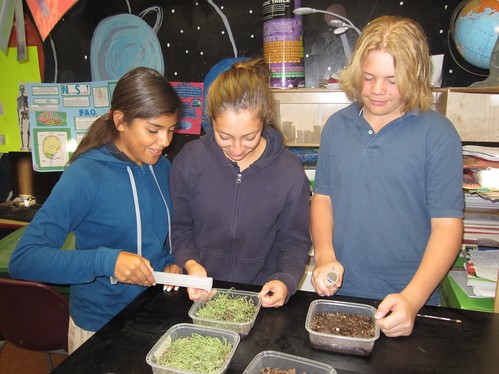
Students participating in a “Climate Change and the Water Cycle” module exercise
Students participate in a “Climate Change and the Water Cycle” module exercise. Photo from the Asombro Institute for Science Education home of the Chihuahuan Desert Nature Park
All this month we will be taking a look at what a changing climate means to Agriculture. The ten regional USDA Climate Hubs were established to synthesize and translate climate science and research into easily understood products and tools that land managers can use to make climate-informed decisions. The Hubs work at the regional level with an extensive network of trusted USDA agency partners, technical service providers, University collaborators, and private sector advisers to ensure they have the information they need to respond to producers that are dealing with the effects of a variable climate. USDA’s Climate Hubs are part of our broad commitment to developing the next generation of climate solutions, so that our agricultural leaders have the modern technologies and tools they need to adapt and succeed in the face of a changing climate.
USDA has created a curriculum for teaching today’s students about climate change and educating tomorrow’s farmers, ranchers, and decision makers.  The Department’s Southwest Regional Climate Hub has partnered with the Asombro Institute for Science education to build “Climate Change and the Water Cycle,” a scientifically rigorous education unit for 6th -12th grade students.  Intended for both formal and informal educators, the unit includes 9 activities which can either stand alone or be taught over 10 instruction hours.  These hands-on activities are designed to help the students understand the scientific concepts behind different elements of the water cycle, climate change, and how to analyze data and communicate results.  Here’s a list of the activities:
  • Insulating You, Insulating Earth – Students model the enhanced greenhouse effect using their own body heat, space blankets and towels.
  • Weather or Climate? You decide – Students use their understanding of the definitions of weather and climate to identify which of the two concepts is better represented by several figures that are presented during the activity.
  • Understanding the difference  Students read a short article and examine reports from the popular media to find out if the American public and media understand the difference between weather and climate.
  • Evaporation Investigation  Students conduct an experiment to investigate the effects of different environmental factors on the rate of evaporation.
  • The Water Cycle Game  This has the students playing the roles of reservoirs and hydrologic processes to illustrate the movement of water in the water cycle.
  • Streams and Steam  This is a board game based on Chutes and Ladders.  The game demonstrates the effects of climate change on the water cycle.
  • Ready, Set, Grow! – Students play the roles of water-intensive and drought-tolerant plants to understand the impacts of climate change on water, primary producers, and the food web.
  • Rainout Shelters – This activity uses data from an actual field experiment that was designed to explore the effects of excluding moisture from desert plant communities; students analyze the data to find out how water availability affects plant growth.
  • Climate Data Jam  In a data jam, students analyze and then showcase climate data by developing a creative project to communicate data trends to nonscientists.
The activities align with Common Core State Standards and Next Generation Science Standards.  The Southwest Regional Climate Hub asked educators to review them for educational practices and scientists to review for scientific accuracy.  Activities were pilot tested among 524 middle and high school students in New Mexico, and outcomes were assessed with pre- and post-tests.  One student commented, “I loved all of the activities!  They are fun and help us understand about what goes on in the world.”  Educators who participated in pilot testing said, “the entire curriculum is great, but I was particularly impressed with the progression of ideas and the variety of lessons,” and “students could see the relevance and importance of these real life issues.”
The downloadable instruction manual with links to PowerPoint presentations and videos and printable student worksheets is easily accessible.  The materials are currently being translated into Spanish.  The second unit of the series entitled, Climate Change and Threats to Agriculture, is in the works and is expected to be completed near the end of 2016.

Skinks with Colorful, Twitching Tails

From the U.S. Fish and Wildlife Service:


A bright blue tail is commonly seen in juveniles of several species of skinks! If captured, it readily detaches. The colorful, twitching tail may distract a predator long enough to allow the young lizard to escape.

Photo: Vicki DeLoach, Creative Commons

Saturday, May 21, 2016

Ozark Hellbenders (Endangered Aquatic Salamanders)

From the U.S. Fish and Wildlife Service Midwest Region:


Ozark hellbenders are endangered aquatic salamanders that grow up to two feet long. Populations are declining due to habitat loss, nest disruption, disease and abnormalities. Learn more:http://1.usa.gov/1OQa37j

Photo: Ozark hellbender by Jill Utrup/USFWS.

The Small, Secretive Sora

From the U.S. Fish and Wildlife Service, Mountain-Prairie Region:


The sora is a small and secretive bird found on both Cokeville Meadows and Seedskadee NWRs. It prefers the oxbow wetlands and developed wetland units on the Refuges. Its distinctive descending whinny call is commonly heard, but actually seeing the little marsh-walker is much more difficult. Photo: Tom Koerner/USFWS