Search This Blog

Saturday, December 3, 2016

Baby Black-footed Ferrets

From U.S. Fish and Wildlife Service, Mountain-Prairie Region:


Good morning! DYK that BFF kits are born blind & helpless & stay underground until they are 2 months old! Credit: Kimberly Tamkun / USFWS


dec0316

Fish need room to be fish!

From U.S. Fish and Wildlife Service, Mountain-Prairie Region:


Fish need room to be fish! What do we mean by that. Many of our streams and rivers are fragmented by large dams, or small poorly placed road culverts that keep fish from accessing habitat . This room to roam, is what many species need to reproduce or escape low water levels and changing water conditions. As a result of fragmentation, species like the #pallidsturgeon are in trouble. But here is help. The U.S. Fish and Wildlife Service has a program that works with local governments, private landowners as well as federal and state partners to keep our fish habitat healthy and find ways to create room to roam. Learn more about Fish and Aquatic Conservation athttps://www.fws.gov/fisheries/whatwedo/nfpp/nfpp.html

Check out this cool #pallidsturgeon being released

From U.S. Fish and Wildlife Service, Mountain-Prairie Region:


Friday, December 2, 2016

FAQ Friday Winter Wildlife Watching

From Rocky Mountain National Park:


FAQ Friday Winter Wildlife Watching

Rocky is a wonderful place to look for wildlife, and many park roads are open in winter to provide access to their wintry world. Bring your field guides and binoculars, and don’t forget your camera. As with any wild animals, you never know when or where you’ll see them, and consider yourself fortunate to see what you can. Winter is an especially good time to look for elk, mule deer, moose, and other large mammals.
Elk and mule deer are most active at dusk and dawn, and are usually seen in meadow areas. Look for elk in Horseshoe Park. Deer Mountain is well-named, being a good place to look for mule deer.
The best place to look for moose is along the Colorado River on the park’s west side.
Look for bighorn sheep along the Highway 34/Fall River corridor on the park’s east side.
Coyotes may be seen any time of day.
Several members of the jay family not only stay for the winter but are residents year-round, including Steller’s jays, with their striking blue bodies and black, crested heads, gray jays, Clark’s nutcrackers, and the iridescent, long-tailed black-billed magpies.
Remember, wildlife can be unpredictable. Approaching animals may cause them stress, leading to disease or illness. If you cause an animal to move or change its behavior, you are too close! For your safety and theirs, enjoy and photograph from a distance.
(Elk and Magpie NPS/VIP Schonlau) ks

Southern Landowners Want to Help At-Risk Wildlife Species

From the #USDA:


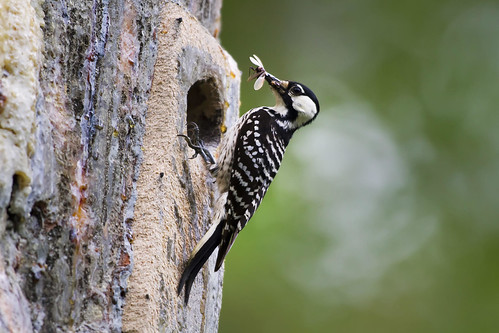
Red-cockaded woodpecker
The red-cockaded woodpecker is an at-risk species under pressure from a loss of forested habitat (Photo Credit: Mary Snieckus)
Amid rising numbers of at-risk wildlife in the South, a new report from the American Forest Foundation (AFF) revealed private and family landowners in the South offer a solution to help at-risk wildlife species.
Southern forests rank at the top in terms of biodiversity when measured by the number of wildlife and plant species. But, due to a variety of reasons, a significant number of the South’s wildlife species are at risk. The reasons include: forest conversion to non-forest uses such as strip malls and commercial expansion; fragmented waterways; natural fire suppression; and an influx of invasive species.
Currently, there are 224 forest-dependent species listed as endangered or threatened. And an additional 293 species could be listed in the near future through a candidate and petitioned process.
At the same time, these Southern forests are some of the most productive, supplying raw material for consumer wood products worldwide. They also supply nearly 1.1 million people in rural communities with jobs.
According to the report, Southern Wildlife at Risk: Family Forest Owners Offer a Solution, family landowners, who own more than 58 percent of forests in the South, are key to providing forested habitat for at-risk species while continuing to fuel the South’s forest economy.
Almost 90 percent of southern landowners say protecting and improving wildlife habitat is the top reason they own land. In addition, 73 percent state they want to do more on their land for wildlife in the future. Landowners cite an uncertainty about whether they are doing right by their land, difficulty finding support and the cost of management, as barriers.
The AFF report highlights it is possible to both protect at-risk wildlife and continue to meet the demands for wood from family lands. The report also found, through a spatial analysis, 35 million areas across the South, where an increase in family and private landowners managing could help protect at-risk species, while providing sustainable wood supplies.
Already projects in these key acre areas are getting started, with a variety of partners, including the American Forest Foundation and the U.S. Forest Service, collaborating. Together the partnerships are conducting outreach to landowners and helping them to connect with trusted resources like foresters and get started managing for wildlife.
According to the U.S. Fish & Wildlife Service, these partnerships have prevented the need to protect more than 70 species across the Southeast. They have also led to improved status or delisting of another dozen species.
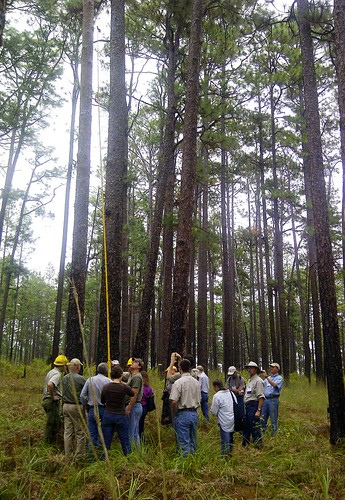
A group of people in a forest
The American Forest Foundation is working collaboratively with partners in key locations to help landowners manage for wildlife. (Photo Credit: Mary Snieckus)

Nanostructured Biosensors Detect Pesticide, Help Preserve Environment

From the #USDA:


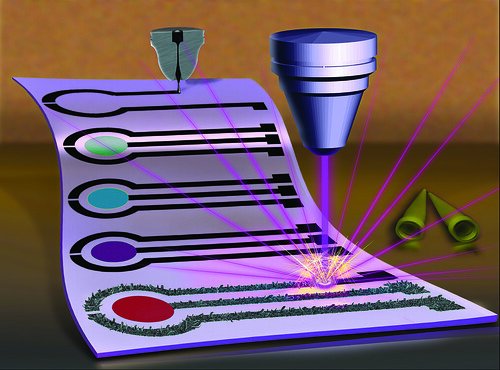
Artist conception of the creation of a biosensor that is created with graphene ink
Artist conception of the creation of a biosensor that is created with graphene ink. (Image reproduced by permission of Dr. Jonathan Claussen from Nanoscale, 2016, 8, 15870.)
When does too much of a good thing become a bad thing? That’s the question Dr. Jonathan Claussen, assistant professor at Iowa State University’s Department of Mechanical Engineering, and his team of researchers aim to help farmers answer when it comes to pesticide use. Underuse can harm farmers’ crops, while overuse can result in runoff into the soil or waterways.
Claussen and his team created a flexible, low cost and disposable biosensor that can detect pesticides in soil. This biosensor is made of graphene, a strong and stable nanoparticle, and provides instantaneous feedback, as opposed to the time and money it would otherwise take to send a sample to a lab and await results.
USDA’s National Institute of Food and Agriculture (NIFA) supported the project with an Agriculture and Food Research Initiative (AFRI) grant as part of the Nanotechnology Program.
The biosensor is made by first printing graphene ink onto paper. A laser then traces over the ink to improve its electrical conductivity by welding together flakes of the graphene ink, making a nanostructured surface that is three dimensional.
“The flakes almost look like rose petals coming up from the surface of the paper,” said Claussen. “They form the base material to test soil on.”
To do this, the biosensor is dipped into a slurry of soil and water. It is then connected to an electrochemical reader in the field to test for pesticide.
“It’s like a pH test strip,” said Claussen. Test results can help farmers quickly understand how much pesticide is needed to maintain healthy crops and minimize environmental damage. Also, results can help farmers understand where environmental remediation may be needed if pesticide overuse is evident.
The biosensor has great potential for use beyond the agriculture community. Its properties can be converted for use in the biomedical, environmental, or food safety fields, simply by changing the biological components that are immobilized on top of it.
“What fascinates me most about this project is the real world impact it can provide,” said Claussen. “The graphene sensors do not require the use of precious metals that are typically used to increase the performance of electrochemical sensors. Therefore, [this] technology really could be used by the masses for flexible/low cost electronics and sensors.”
NIFA invests in and advances innovative and transformative research, education and extension to solve societal challenges and ensure the long-term viability of agriculture. USDA has invested $19 billion in research and development since 2009, touching the lives of all Americans from farms to the kitchen table and from the air we breathe to the energy that powers our country. Learn more about the many ways USDA scientists are on the cutting edge, helping to protect, secure and improve our food, agricultural and natural resources systems in USDA’s Medium Chapter 11: Food and Ag Science Will Shape Our Future.

Thursday, December 1, 2016

Fighting Coots

From U.S. Fish and Wildlife Service, Mountain-Prairie Region:


The fight is on between these coots from the 2016 Bear River Photo contest. Credit: Velvet Shearer / USFWS