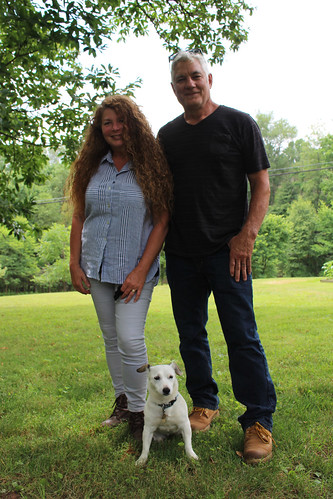
Natalie and Donald Love use sustainable forestry practices to improve early successional habitat on their land in central Pennsylvania.
Natalie Love wakes up each morning to the sounds of songbirds. “What a good way to start your day,” said Love, who lives in the Appalachian Mountains in central Pennsylvania.
Natalie and her husband Donald are working to improve the healthy, structurally diverse forests that provide many benefits for wildlife. By doing so, they’ve also improved their access to their forests, fought off undesired invasive plants and improved the aesthetics of their forest land.
“Sustainable forestry is benefitting our personal lives as well as wildlife,” she said. “We want to build an inviting place for the golden-winged warbler.”
The
golden-winged warbler is a vibrantly-colored migratory songbird that breeds and nests in the United States and spends its winters in Central and South America. On its breeding grounds, the warbler requires expansive forested landscapes comprised of young forests, and patches of shrub land interspersed among forests of various ages that the warbler needs for nesting.
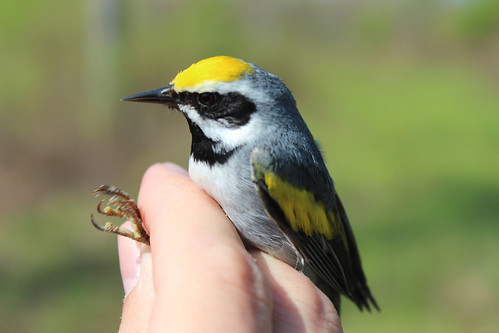
The golden-winged warbler is a vibrant, neotropical songbird that breeds in Appalachia and Midwest.
Early successional habitat on the bird’s breeding range, the Upper Midwest and Appalachian Mountains, has declined over the past 50 years as aging forests have come to dominate huge expanses.
Both game and non-game species that rely on younger forests are in decline, including the golden-winged warbler, which has suffered a 66 percent population decline since the 1960s. This major shift in the age classes of forests is the result of a lack of fires in recent years and unsustainable forestry practices that do not result in healthy, structurally diverse forests.
The Loves and other private landowners are voluntarily stepping up to manage for diverse forests on their land. With the help of USDA’s
Natural Resources Conservation Service (NRCS) and other conservation partners, they are implementing a forest management plan to establish and improve young forests, or early successional habitat, on 70 acres.
By controlling invasive weeds and selectively removing trees, the Loves have attracted a variety of songbirds and wildlife. They have also created an aesthetically appealing wooded setting that has enhanced their property for family and visitors to the Airbnb cottage on their land. Through this management, they’ve been able to create walking trails on the land and enhance wildlife viewing opportunities.
“We found that people like the woods,” Love said. “They like to walk the trails and experience nature up close. We have been able to provide a place for people to explore nature and leave the woods better than what we moved into.”
In addition to NRCS, other partners included Indiana University of Pennsylvania, Pennsylvania Game Commission, American Bird Conservancy and Pennsylvania Department of Conservation and Natural Resources, who helped the Loves through the planning and implementation processes.
“We liked the idea of bringing birds in and having specialists help us be good stewards of the land,” said Donald Love.
Scientists for Indiana University of Pennsylvania and Cornell University are monitoring the response of wildlife to the forestry work, and have surveyed songbird response on the Love’s forests that were enrolled in
Working Lands for Wildlife (WLFW).
“In only a couple of years since they have stepped up management, the diversity of songbirds is already impressive in the Love’s WLFW forest,” said Jeff Larkin, golden-winged warbler breeding habitat coordinator for the Indiana University of Pennsylvania and American Bird Conservancy. “We have recorded 29 species of songbirds including several at migratory species such as wood thrush, Louisiana waterthrush, scarlet tanager, indigo bunting, prairie warbler, ovenbird and hooded warbler. We have also detected the nocturnal songster, the eastern whip-poor-will.”
Habitat restored for the golden-winged warbler also benefits many other species, including songbirds like indigo bunting and prairie warbler, as well as game species like American woodcock, wild turkey, deer and grouse.
NRCS provides technical and financial assistance to the Loves through WLFW, an NRCS-led partnership that restores key working landscapes using target species, such as the golden-winged warbler, as barometers for success. Since 2012, the agency has helped landowners restore more than 13,000 acres of early successional habitat in the Appalachian region, including 8,000 acres in Pennsylvania alone.
“Most forest land in Appalachia is privately owned, making landowners pivotal to the bird’s success,” NRCS Chief Jason Weller said. “Stewardship-minded landowners, like the Loves, are stepping up to help the golden-winged warbler and other wildlife while also managing healthy, more productive forests.”
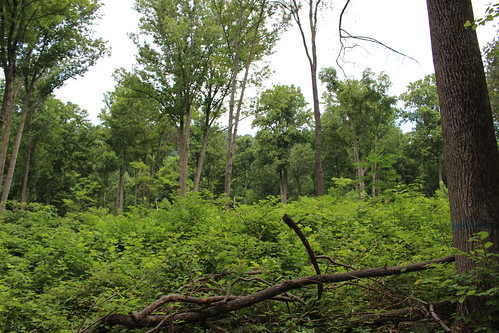
By controlling invasive weeds and selectively removing trees, the Loves have attracted a variety of songbirds and wildlife.


