Search This Blog

Thursday, August 25, 2016

Minneapolis Students Gear up for a School Year Full of Fresh, Locally Grown Foods

From the #USDA:


MPS Jr. Iron Chef Competition with Chef Ann Kim
MPS Jr. Iron Chef Competition with Chef Ann Kim and a True Food Chef Council member
It’s that time of year – books, backpacks and a BBQ!   That’s right – Minneapolis Public Schools (MPS) is preparing for its annual Farm to School Community BBQ, a much anticipated back-to-school event that kicks off the school year.  The following guest blog features inspiring initiatives MPS has implemented to serve local foods to its 35,000 students in the district.
Since 2011, MPS has sourced fresh produce, meats, baked goods and other products from local farmers and manufacturers.  Purchasing local foods supports Minnesota farms and small businesses and provides opportunities for students to learn how their food is grown by extending farm to school efforts beyond the cafeteria and into the classroom with visits from farmers and taste-tests.
Farm to school also helps to support another USDA initiative designed to enhance school meals – theWhat’s Shaking? Creative Ways to Boost Flavor with Less Sodium initiative.   Using local foods means that school nutrition programs are preparing more meals from scratch, allowing them to control the amount of sodium. Farm to school gets students engaged and excited about school meals – and with the community BBQ, both kids and their families get a sneak peek at what’s going to be on the lunch menu for the new school year.
By Kate Seybold, Farm to School Coordinator, Minneapolis Public Schools
What better way to ring in the new school year than by celebrating the bounties of local produce that farmers harvest during the back-to-school season?  Minneapolis Public Schools (MPS) is hosting itsFifth Annual Farm to School Community BBQ – a community event built around fresh food, families and fun! The event brings together MPS students and their families, school staff, local farmers and vendors, True Food Chef Council members and other community partners in celebration of Minnesota Farm to School Month and our farm to school program.
It’s also a great opportunity to give the community a taste of our school food! This year, we expect around 1,000 attendees to join our local food celebration, which generates student excitement and family awareness about the abundance of local fresh fruits and vegetables that farmers grow in our area and that we serve on school salad bars and in delicious, made-from-scratch recipes featured on our school lunch menu!  The evening will be filled with tons of roasted corn and other farm to school foods – along with dozens of fun activities and live music.  The highlight of the night is the corn-shucking contest to see who can shuck the most ears of corn in only a few minutes.
The 2016-2017 school year marks the fifth year of MPS’ Farm to School Program.  Since 2012, MPS has worked with small to mid-size, sustainable growers in our area to incorporate a variety of vegetables and fruit into our school meals.  New farm to school foods are often introduced as a trial-run on the menu to allow us to gauge students’ responses and make decisions about moving forward with items.  Last year, students went crazy over the roasted cauliflower and the fresh honeydew melon – they loved them!  This year, we’ll buy everything from Brussels sprouts to kohlrabi to sweet potatoes, from more than 15 local farms.   The sweet potatoes are featured as sweet potato jo-jo’s and in our “Beets and Sweets” menu item – which are roasted sweet potatoes and beets.  The kohlrabi is made into a fresh slaw with carrots, apples and ginger.
Along with buying local, our farm to school program works closely with our community partners to provide food education and to interact with the broader community through our Minnesota Thursdaysmeals, True Food Taste TestsJr Iron Chef Competition, farmer classroom visits, and much more.  These activities encourage students to be more adventurous eaters and educate them about where their food comes from.
Our farm to school initiative has also helped us meet and exceed the guidelines to keep sodium minimal in school meals.  Also, less food seems to go to waste with fresh, flavorful scratch-cooking.   At the end of each school year, we ask our school nutrition staff to complete surveys about popular farm to school menu items among their students.  This information helps us to decide which items we would like to procure the following year through our farm to school program.
Building our farm to school program has been a learning process.  We decided the best way to help other districts join this local food movement would be to share all the lessons we learned along the way! Our recently published Farm to School Toolkit has tools and resources that have been developed since the program’s inception in Minneapolis.
To learn more about farm to school programs, check out the Community Food System’s Webpage and to explore local and regional food systems in your community, visit the Know Your Farmer, Know Your Food Compass and the USDA Farm to School Census.   Also, USDA’s What’s Shaking? Creative Ways to Boost Flavor With Less Sodium, a national sodium-reduction initiative, fosters creative ways to boost flavor and maximize taste to support efforts to lower the sodium content of school meals.
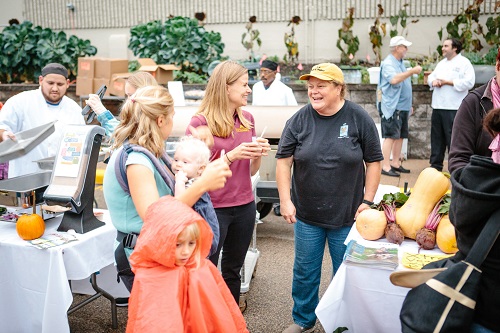
Rae Rusnak chatting with MPS families at the Farm to School Community BBQ
Rae Rusnak (L & R Poultry and Produce) next to her squash and beets, chats with MPS families at the Farm to School Community BBQ

Ovenbird

From U.S. Fish and Wildlife Service Midwest Region:


Ovenbirds are named after their covered nests. Like a Dutch oven, the shape forms a dome and side entrance.

Photo: Ovenbird courtesy of Max Rae/Creative Commons. https://flic.kr/p/dN5VNA


Google Doodle Celebrating U.S. National Parks

Katahdin Woods and Waters National Monument

From the U.S. Department of the Interior:


Today President Obama designated Katahdin Woods and Waters National Monument -- our nation’s newest national monument and the 413th site in the national park system. Katahdin Woods and Waters National Monument will permanently protect north-central Maine’s awe-inspiring mountains, forests and waters for current and future generations. The approximately 87,500 acres that make up the new national monument is rich in biodiversity and known for its outstanding opportunities to hike, canoe, hunt, fish, snowmobile, snowshoe and cross-country ski. What a great way to kick off the National Park Service’s next 100 years of conservation! Photo courtesy of Bill Duffy.

Wednesday, August 24, 2016

USDA Blog » Celebrate 50 Years of Protecting Animals with APHIS

Many people know that the Animal and Plant Health Inspection Service (APHIS) is the agency tasked with administering the Animal Welfare Act (AWA).  But did you know that this is the 50th anniversary of that Act?
In 1965, a Dalmatian named Pepper was stolen from her backyard by a dealer, who then sold her to a hospital.  Pepper was used in research and subsequently died.  The public outcry was, understandably, enormous, including coverage in several major magazines.  As a result, Congress passed the Laboratory Animal Welfare Act – the precursor to the AWA – in 1966, and tasked the U.S. Department of Agriculture to ensure the health and wellness of animals used in research.


USDA Blog » Celebrate 50 Years of Protecting Animals with APHIS

UPS Pursues Ambitious Sustainability Research Projects With U.S. Department Of Energy To Power The Future Of Trucking

A pair of Department of Energy grants awarded to UPS (NYSE: UPS) will enable the company and a world-class team of engineers to conduct cutting-edge research aimed at reducing emissions and revolutionizing the charging process for electric trucks.


UPS Pursues Ambitious Sustainability Research Projects With U.S. Department Of Energy To Power The Future Of Trucking

Partners in Conservation: Red Cedar Demonstration Farm Offers Hands-On Education

From the #USDA:


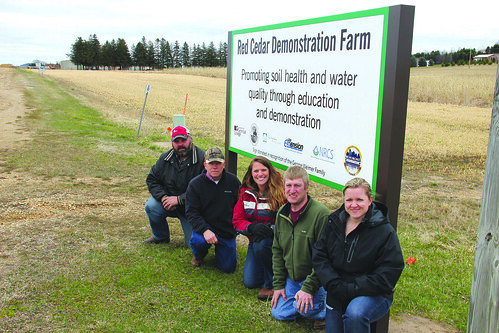
Mark Denk, CVTC; Dan Prestebak, Dunn County Land & Water; Katie Wantoch, UW-Extension; John Sippl, USDA-NRCS; and Leah Nichol, Dunn County Land & Water
(L to R) Mark Denk, CVTC; Dan Prestebak, Dunn County Land & Water; Katie Wantoch, UW-Extension; John Sippl, USDA-NRCS; and Leah Nichol, Dunn County Land & Water proudly promote soil health and water quality through education and demonstration at the Red Cedar Demo Farm.
In Menomonie, Wisconsin, there is a 155-acre, three-parcel farm, whose purpose is to educate and demonstrate natural resources conservation. As part of their curriculum, Chippewa Valley Technical College (CVTC) Agricultural Program students perform farm work there in an outdoor classroom environment.
“The Red Cedar Demonstration Farm gives students a hands-on opportunity to plant, scout fields, monitor growth, harvest, write nutrient plans, take soil samples. Really, it’s a full farm laboratory for students,” said John Sippl, Dunn County Natural Resources Conservation Service (NRCS) District Conservationist.
The farm began through partnership. “In 2015, a partnership was formed,” Sippl says. “We started implementing soil health practices, nutrient management standards, no-till, and cover crops.”
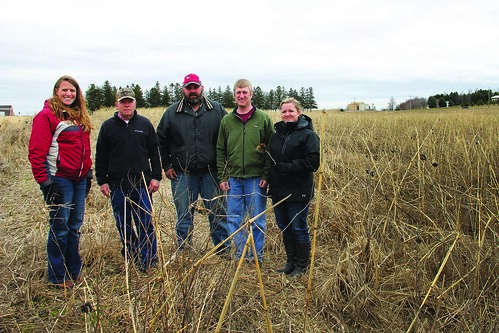
Katie Wantoch, UW-Extension; Dan Prestebak, Dunn County Land & Water; Mark Denk, Chippewa Valley Technical College; John Sippl, USDA Natural Resources Conservation Service; and Leah Nichol, Dunn County Land & Water
(L to R) Katie Wantoch, UW-Extension; Dan Prestebak, Dunn County Land & Water; Mark Denk, Chippewa Valley Technical College; John Sippl, USDA Natural Resources Conservation Service; and Leah Nichol, Dunn County Land & Water tour a full season cover crop plot on the demo farm.
The partners – NRCS, Dunn County Land and Water, University of Wisconsin-Extension, and the CVTC – presented a demonstration and educational farm idea to the county board. They agreed to a five-year lease to implement conservation practices to educate students, partners, and the community on soil health and its benefits.
“They saw different agencies coming together to form a truly interactive partnership to look at conservation management,” said Dan Prestebak with Dunn County Land & Water. “This was instrumental to the committee approving our ideas for the project.”
When the partners first visited the site, they saw the effects of wind erosion, but also saw the potential for improving the health of the soil.
But what about now? Students plant corn, small grains, and soybeans. No-till is used on the majority of the land and cover crops are also being used after each crop harvest. Students learn how to use tillage equipment on a control strip, to compare to no-till areas, where conservation practices are implemented.
“We’re seeing results!” said Sippl.
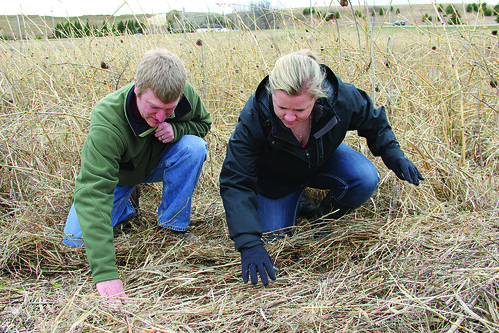
Sippl and Nichol assessing clover cover crop establishment
Sippl and Nichol assess clover cover crop establishment.
Cover crops are also planted on the field, a multi-species mix of a winter annual, a brassica species, and clovers.
“With multi-species cover crops on the ground, we’ve seen an abundance of wildlife—more than we’ve ever seen before,” said Sippl.
The soybeans had winter rye cover crop drilled in and will be harvested for grain in the summer. Corn fields were aerial seeded with a winter cover crop when corn was still standing. Lime and urea are also being applied for nutrient management.
“By incorporating crop diversity into the system, we saw better infiltration rates in just one years’ time,” said Sippl.
“We’re demonstrating it is possible to utilize no-till and cover crops, build organic matter, change the biological diversity in the soil, infiltrate more water, decrease erosion, increase soil health and more,” said Sippl. “We have an opportunity to show how conservation efforts can make an impact long term. We’re all excited to see the difference conservation can make in educating our next generation.”
CVTC has a unique partnership with the local implement dealers to allow students to use equipment for educational purposes. “We bring students to learn; we look at agronomy, marketing, and the financial side of harvesting. We’re excited to be a hands-on member of this partnership,” said Mark Denk, CVTC Instructor.
The main goal for the demo farm is conservation education. “NRCS, Dunn County Land & Water, UW-Extension, and CVTC. We’ve always had a good relationship, but this project has really strengthened that relationship and it’s been great for the students and community also,” said Prestebak.
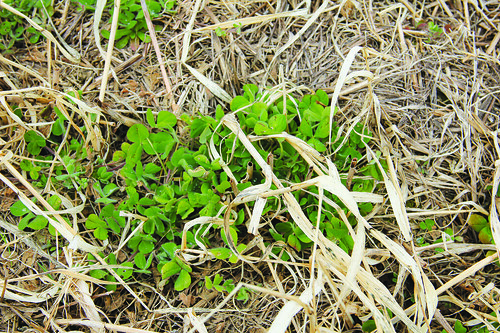
Cover crop seeded into corn residue
Cover crop seeded into corn residue.