Non-Hazardous Secondary Materials Final Rule builds upon the base regulatory program established in 2011.
EPA finalizes NHSM Rule to include C&D wood and paper recycling residuals - Renewable Energy From Waste
Thursday, February 25, 2016

Innovative Irrigation Saves Water, Boosts Yields in Ogallala Aquifer Region
From the #USDA:
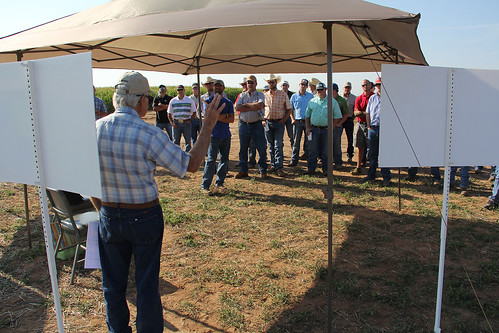
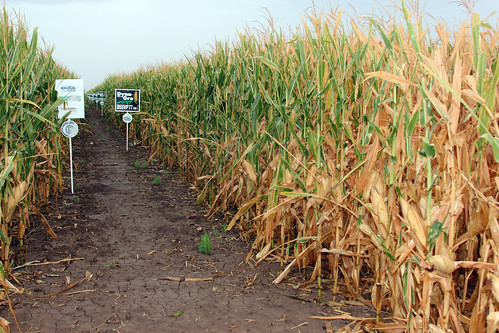
Project Manager Leon New discusses the progress of the 3, 4, 5 demonstration project at a 2015 district producer field day.
In the Ogallala Aquifer region, each drop of water counts. A group of forward-thinking farmers in Texas are finding innovative ways to irrigate their crops to use water more efficiently.
These farmers are working with the North Plains Groundwater Conservation District in the panhandle to study use of water from the aquifer. The Ogallala is the nation’s largest aquifer and is being depreciated by water withdrawals at an unsustainable rate.
The district received assistance from USDA’s Natural Resources Conservation Service (NRCS), both through the Ogallala Aquifer Initiative and a Conservation Innovation Grant. The grant programs help conservation districts and other organizations test innovative approaches and technologies.
In the Conservation District’s 3, 4, 5 Project farmers irrigated corn at different rates to evaluate whether lower irrigation rates could still produce profitable yields. The producers irrigated at three, four and five gallons per minute depending on the field.
“The purpose of this demonstration is to see if we can produce similar corn yields with less irrigation and supplemental rainfall,” said Leon New, the district’s project manager. “We have yield differences in the fields and we are anxious to learn what they are in relation to measured water.”
The results showed that at three gallons per minute: Yields averaged 226 bushels per acre with a net return of $463; at four gallons per minute: Yields averaged 238 bushels per acre with a net return of $483; and at five gallons per minute: Yields averaged 255 bushels per acre with a net return of $513.
While the net returns were higher as more water was pumped, farmers grew more corn per gallon when they irrigated at lower rates. And with less water, farmers still produced profitable yields.
“I am impressed by the trial results the district has released for the first year of the 3, 4, 5 Project,” said Mike Caldwell, NRCS resource team leader in Dumas, Texas. “It’s interesting to know that the crops with less water, applied at three gallons per minute per acre had the deepest root systems. This shows that the crops roots were using water in the entire soil profile with no water waste. It’s important to know this at a time when water levels are continuing to decline.”
With NRCS help, the district is evaluating water use in the region. The district is also sharing this information with others. The district has held field days on some of the farms participating in the project, giving other farmers a chance to see how corn plants were responding to the different irrigation rates.
Learn more about NRCS’ Conservation Innovation Grants program and Ogallala Aquifer Initiativeonline. For more on technical and financial assistance available through conservation programs, visitwww.nrcs.usda.gov/GetStarted.
NOTE: For an interactive look at USDA’s work in conservation and forestry over the course of this Administration, visit http://medium.com/usda-results.
The 3, 4, 5 demonstration project is equipped with seven center pivot sprinkler irrigation systems irrigating 15 fields.
Are you sure the Tenors started this way?
From USFWS National Wildlife Refuge System:

Are you sure the Tenors started this way?
Thank you Pat Stoj for our best caption.
And for those who love puns, Sam Greenlee offers,
Quit your harping! I harbor no eel will toward you!”
There are 32 species of seals. Their body shape – round in the middle, tapered at the ends – is adapted to fast, graceful swimming. Sea lions and fur seals have external ears and longer flippers than earless seals. All seals come ashore once a year to breed, often in great herds on beaches or ice. There are seals on many refuges, and a seal pupping cam on Seal Island Refuge, Maine.www.fws.gov/refuges/news/

Are you sure the Tenors started this way?
Thank you Pat Stoj for our best caption.
And for those who love puns, Sam Greenlee offers,
Quit your harping! I harbor no eel will toward you!”
There are 32 species of seals. Their body shape – round in the middle, tapered at the ends – is adapted to fast, graceful swimming. Sea lions and fur seals have external ears and longer flippers than earless seals. All seals come ashore once a year to breed, often in great herds on beaches or ice. There are seals on many refuges, and a seal pupping cam on Seal Island Refuge, Maine.www.fws.gov/refuges/news/
Morphed Blue Goose
From USFWS_Pacific Southwest Region:

DYK: Morphed blue geese are said to be the inspiration for the blue goose emblem of the National Wildlife Refuge System – here’s the full story about that http://1.usa.gov/1T4PF1S
Photo by Doug Croft

DYK: Morphed blue geese are said to be the inspiration for the blue goose emblem of the National Wildlife Refuge System – here’s the full story about that http://1.usa.gov/1T4PF1S
Photo by Doug Croft
Gills and pills: Fish testing positive for cocaine, anti-depressants
This is probably only a partial list. - JBK
Fish found in Washington’s Puget Sound are tripping on cocaine, Prozac, Advil, Benadryl, and Lipitor. Unfortunately, there is no aquatic drug dealer responsible for it. Instead, the intoxication is the result of tainted discharge water.
Pharmaceutical pollution could be to blame for the many drugs showing up in the tissues of juvenile Chinook salmon. Estuary waters near the sewage treatment plants were found to contain a cocktail of up to 81 different drugs, according to a new study out of the National Oceanie and Atmospheric Administration (NOAA).
https://www.rt.com/usa/333543-fish-cocaine-seattle-puget/
Wednesday, February 24, 2016
How Do You Manage Collaborative Conservation Planning across 100 Million Acres? From a Bird's Eye View, of Course!
From the #USDA:
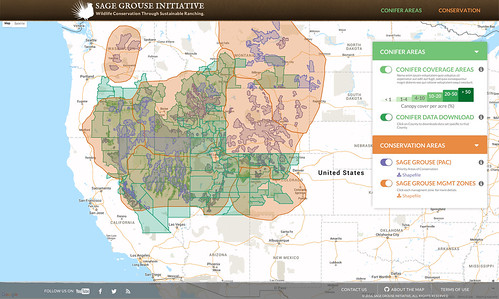
The SGI Interactive Web Application enables conservationists to help plan the best conservation efforts to restore sage grouse habitat. (Click to enlarge)
The saying “The whole is greater than the sum of its parts” is often attributed to the Greek philosopher Aristotle, and that couldn’t be more true when it comes to doing conservation planning across 11 states, multiple federal agencies and millions of acres of public and private land.
The Sage Grouse Initiative (SGI), led by USDA’s Natural Resources Conservation Service (NRCS), introduces the SGI Interactive Web Application, a tool that will take habitat restoration efforts for sage grouse to new heights — both visually and on the ground. The tool graphically layers vital pieces of information to paint a more cohesive picture of connected landscapes, so state and federal agencies and their partners can make more effective and targeted decisions.
For instance, the web application includes a brand new high-resolution map of conifer encroachment across 100 million acres of sagebrush-steppe landscape. Invading conifers degrade the sagebrush landscape by crowding out native plants, that’s why NRCS and its partners target their removal when they’re young.
Conifers are just one layer. Each layer added will help address threats that NRCS is prioritizing through the Sage Grouse Initiative 2.0 investment strategy, a four-year $211 million effort to help conserve sagebrush habitats in 11 Western states. A second layer available depicts the ecosystem’s resilience and resistance based on underlying soil temperature and moisture,” said Jeremy Maestas, NRCS regional biologist.
“Someone using the application will be able to visualize which areas are more or less likely to rebound after wildfire and resist cheatgrass invasion,” Maestas said. “By putting these cutting-edge products at the fingertips of practitioners and landowners, it helps us more quickly apply science and technology into targeted action on the ground.”
The SGI partnership is in the process of adding more layers to the web application and layers will be periodically updated to reflect the most recent scientific information.
Brady Allred, a rangeland specialist with University of Montana, developed the tool for SGI using Google Earth Engine, a platform for petabyte-scale scientific analysis and visualization of geospatial datasets, both for public benefit and for business and government users.
“By using Google Earth Engine, we are able to do range-wide science and conservation planning that was functionally impossible before,” Allred said. “And because Google Earth Engine is built for the web, we can immediately implement that science into planning and decision making.”
Soon the web application will be completely interactive, allowing the user to change analysis parameters, input new data, or specify an area of particular interest for a more detailed analysis. It gives the user the ability to get the exact information he or she needs.
“Geography is not a barrier here,” Allred said. “By focusing on the entire western half of the country, we are able to get the whole picture—a better view of what is occurring. This improves conservation planning for all western rangelands.”
Since 2010, NRCS has worked with ranchers to restore and protect more than 5 million acres of sage grouse habitat through SGI. This work was part of a large landscape-level effort that led the U.S. Fish and Wildlife Service to conclude last year that the sage grouse did not warrant protection under the Endangered Species Act.
Learn more about NRCS’ conservation efforts for sage grouse. For more on technical and financial assistance available through conservation programs, visit www.nrcs.usda.gov/GetStarted.
Tuesday, February 23, 2016
Those Nasty Old Zebra Mussels
From U.S. Fish and Wildlife Service: Fisheries

Brought here from Europe in ships’ ballast water; zebra mussels were first discovered in the Great Lakes region in 1988. Zebra mussels have inflicted tremendous damage to native ecosystems and to facilities using water. And, as zebra mussel populations in an area increase, native mussels decrease; a strong indication that zebra mussels are the cause. #NISAW
More on Zebra and Quagga Mussels at http://
Clean, Drain, Dry - http://bit.ly/1pL6PAK
Wildlife Forever
#InvasiveSpecies

Brought here from Europe in ships’ ballast water; zebra mussels were first discovered in the Great Lakes region in 1988. Zebra mussels have inflicted tremendous damage to native ecosystems and to facilities using water. And, as zebra mussel populations in an area increase, native mussels decrease; a strong indication that zebra mussels are the cause. #NISAW
More on Zebra and Quagga Mussels at http://
Clean, Drain, Dry - http://bit.ly/1pL6PAK
Wildlife Forever
#InvasiveSpecies
Subscribe to:
Posts (Atom)