From the U.S. Fish and Wildlife Service, Mountain-Prairie Region:
The Aztecs believed that warriors who died in battle would be reincarnated as...hummingbirds? Say what?!? Yep, you read that right. The Aztecs knew something that most modern people don't: ounce-for-ounce, a tiny bird that weighs less than a nickel may be the fiercest animal on earth. Here's a simple way to look at it: hummingbirds need a lot of fuel to survive. And we mean a lot. Every day hummingbirds eat about half of their body weigh in sugar. If you're a 200-pound man, that roughly amounts to you drinking 1,100 cans of Coca-Cola each and every day!
This means that hummers are constantly on the lookout for food - and they get very defensive about their territories - so much so that they've been documented chasing away birds much larger than themselves - jays, crows, hawks, even bald eagles! The Aztecs so highly valued the bravery and prowess of the hummingbird that their high priests regularly cut the hearts out of their captured enemies and slaves as a sacrifice to the hummingbird god. Aztec kings wore ceremonial cloaks made entirely from hummingbird skins. It took up to 8,000 skins to make a single cloak! And just think, all you need to lure these war gods to your backyard is a feeder full of sugar water!
(Photo by Andrew E. Russell / Creative Commons)
Hat tip to Jason Bittel, whose article "Hummingbirds Are Fierce, Deadly Gods of War" in Slate Magazine inspired this post. Check it out for a more in-depth look into these amazing birds: http://slate.me/1MDhNHr.
Protecting natural resources, including air, land and water. Also of interest are threatened and endangered species as well as endangered species. Conservation (wildlife, soil, water, etc.) issues also discussed. Topics include: RCRA, CERCLA, Clean Water Act (CWA), NEPA, 404 Permits, EPCRA, FIFRA, and others.
Search This Blog
Monday, August 24, 2015
Sandhill Cranes Coming to Texas
From the USFWS National Wildlife Refuge System:
Plan ahead! Sandhill cranes usually begin to arrive at Muleshoe National Wildlife Refuge in Texas in September. The numbers peak between December and February, when thousands can be seen at any one time. Within the refuge’s short-grass prairie are three main playa lakes -- Goose, White and Paul’s – whose only source of water is rainfall. When full, the lakes provide nearly 600 acres of water for wildlife. The water is especially important to migratory birds within the Central Flyway.
Photo by Christena Stephens
About Muleshoe National Wildlife Refuge:1.usa.gov/1Jnz6uK
Plan ahead! Sandhill cranes usually begin to arrive at Muleshoe National Wildlife Refuge in Texas in September. The numbers peak between December and February, when thousands can be seen at any one time. Within the refuge’s short-grass prairie are three main playa lakes -- Goose, White and Paul’s – whose only source of water is rainfall. When full, the lakes provide nearly 600 acres of water for wildlife. The water is especially important to migratory birds within the Central Flyway.
Photo by Christena Stephens
About Muleshoe National Wildlife Refuge:1.usa.gov/1Jnz6uK
Recycling-Weltmeister Deutschland | Wissen & Umwelt | DW.COM | 24.08.2015
Müll hatte lange Zeit keinen Wert. Er wurde verbrannt oder vergraben - bis die Wirtschaft ihre Produkte recyceln musste und Bundesbürger begannen, ihren Abfall nach Wertstoffen zu trennen. Eine Erfolgsgeschichte.
Recycling-Weltmeister Deutschland | Wissen & Umwelt | DW.COM | 24.08.2015
Sunday, August 23, 2015
Barred Owls
From the U.S. Fish and Wildlife Service Midwest Region:
Barred owls aren’t much for traveling. They don’t even move around much to hunt! They enjoy a varied diet including anything from small mammals and reptiles to invertebrates.
Photo: Barred owl with crayfish courtesy of Matthew Paulson/Creative Commons.
Barred owls aren’t much for traveling. They don’t even move around much to hunt! They enjoy a varied diet including anything from small mammals and reptiles to invertebrates.
Photo: Barred owl with crayfish courtesy of Matthew Paulson/Creative Commons.
Saturday, August 22, 2015
Minnesota Farmer Commits a Century of Life to Agriculture, Dedicating Three Decades to Conservation
From the #USDA:
Posted by Brenda Carlson, Public Affairs Specialist, USDA Farm Service Agency, on August 21, 2015 at 3:45 PM

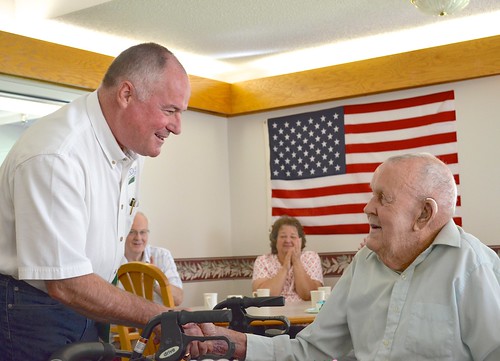
FSA Administrator Val Dolcini celebrates Art Hulberg's 100th Birthday and his 30 year commitment to the Conservation Reserve Program (CRP). Photo courtesy of Deb Mercier, News Editor, Pope County Tribune
When Minnesota farmer and conservationist Arthur “Art” Hulberg celebrated his 100th birthday this month, he also marked the 30th anniversary of USDA’s Conservation Reserve Program (CRP)–a program in which Hulberg has participated since its inception. Farm Service Agency (FSA) Administrator Val Dolcini traveled to Benson, Minnesota, to offer birthday wishes and hand deliver a personal letter from Agriculture Secretary Tom Vilsack.
Hulberg and his brother Clifford farmed nearly 200 acres in Pope County, Minnesota. When CRP began, the Hulbergs eventually enrolled 188 acres in the program. When Clifford passed away in 1989, Art took over as full owner of the property and to this day works with USDA staff to manage his CRP acres. For example, when the Walk-In-Access (WIA) program began, Hulberg immediately enrolled to allow for hunting on his CRP acreage. WIA is supported by a grant through the USDA’s Voluntary Public Access Program that assists with public access to CRP for wildlife-dependent recreation. Hulberg also has helped fellow farmers and livestock producers in his community by allowing them to use his CRP acres for managed haying practices.
In his letter to Hulberg, Secretary Vilsack said, “It is a true privilege to be a part of the celebration marking your birthday and honoring your longstanding commitment to conservation work… you can contemplate your many outstanding contributions to our Nation with deep satisfaction. You have meant a great deal to a great many people, and your dedicated work on behalf of conservation is an inspiration to us all.”
When a guest asked Hulberg how he felt about the Secretarial letter and visit by FSA Administrator Dolcini during an open house to celebrate the milestones, Hulberg responded, “Did I just dream this?”
Dolcini says that meeting Art was one of the most meaningful things that he has done since becoming FSA Administrator. When asked by Dolcini of his secret to longevity, Hulberg thoughtfully replied, “Take it one day at a time.”
Since its creation on Dec. 23, 1985, CRP has prevented more than 8 billion tons of soil from erosion, and protected more than 170,000 stream miles with riparian and grass buffers, more than 100,000 acres of bottomland hardwood trees, nearly 300,000 acres of flood-plain wetlands, and 250,000 acres each for duck nesting habitat and upland bird habitat.
For an interactive tour of CRP success stories from across the U.S., please visit the FSA CRP 30th Anniversary website at www.fsa.usda.gov/CRPis30.

Surrounded by family and friends in Benson, Minnesota, Art Hulberg celebrated 100 years of life and 30 years of conservation during an open house gathering in his honor. Photo courtesy of Deb Mercier, News Editor, Pope County Tribune.
Related Posts
100 Years of U.S. Forest Service Research and Development
From the #USDA:
Posted by Tom Tidwell, Chief, U.S. Forest Service, on August 21, 2015 at 12:00 PM

U.S. Forest Service Chief Tom Tidwell.
U.S. Forest Service Research and Development celebrates a century of existence this year and while we don’t all get the opportunity to work directly with our researchers and scientists, we all benefit from their contributions.
We are extremely fortunate as an agency to have our own Research & Development branch. It has allowed us to not only develop the science that we need to do our jobs but also to apply it to our present and future initiatives. We are a science-based organization and many of the solutions to the challenges we face derive from the team’s work.
This is especially true with climate change. We are seeing the results of 20, maybe even 30, years of prior research by our scientists. Because of their efforts we are now well-positioned to understand what needs to be done in regards to managing our ecosystems to assure the successful adaptation of our nation’s forests, vegetation and grasslands.
Breakthroughs exist almost every day in the work they do, especially with the latest announcement that we may be close to providing a solution to address the white nose syndrome plaguing our bat populations.
The solutions our researchers discover not only apply when managing resources, but can also assist us in understanding the economics and, perhaps more importantly, the social side of our efforts. We have a tendency to think about research and development primarily as it relates to the biological and physical side of science but the economics and social science must not be overlooked.
I want to take this opportunity to thank all of our employees who contribute to the amazing research and innovations being done across the enterprise. It is through your contributions that we are able to move forward in fostering the mission of our agency. The work you do reaches us all. It shouldn’t be just one month of the year that that we focus on the great work being done, it should be every day.
Thank you for all that you do.
Tom Tidwell,
Chief, U.S. Forest Service
Related Posts
An NRCS Earth Team Volunteer Gives Her Perspective
From the #USDA:
Posted by Raquel MacSwain, Volunteer, Natural Resources Conservation Service, Minnesota, on August 20, 2015 at 1:00 PM

Raquel MacSwain, NRCS Earth Team Volunteer. Photo credit: Julie MacSwain.
I experience a sense of passion and pride towards something greater than myself every time I volunteer with an organization that directly benefits others, such as serving with USDA’s Natural Resources Conservation Service (NRCS) as an Earth Team Volunteer.
I have been with NRCS since 2008 – volunteering nearly 100 hours over my summer breaks and a few hours a week while in school – assisting the public affairs specialist for NRCS in Minnesota. Through my familiarity with social media, I help by developing messaging for Twitter, promoting upcoming media events, as well as other clerical tasks like designing PowerPoint slides for presentations for employee meetings.
Although these tasks may seem insignificant, even the simplest tasks can contribute to the overall goal of conservation. Even though I wasn’t working directly with people on farms and seeing the gratitude on their faces, volunteering has provided me with invaluable skills.
As a child, I grew up with my family constantly discussing agricultural issues and solutions, which for the most part seemed a little over my head. However, I have learned that as a volunteer with NRCS, I am respected and appreciated for my service, regardless of my agricultural knowledge. This organization allows its volunteers to get hands-on experience in a variety of career fields – from human resources to soil conservationist.
Volunteering is a great way to give back to the environment and community. It’s an experience that changed my life not only environmentally, but of how much I can serve my community.
It gave me the confidence to explore other realms of community services, such as Summer Stretch or Students Today Leaders Forever, which gave me experience working directly with youth. Additionally, this assurance also carried over into my involvement with various organizations at Ripon College, such as Alpha Chi Omega or Black Student Union, which both in broad terms emphasize standing up for something bigger.
Being an NRCS Earth Team volunteer led me to where I am today – an AmeriCorps member working with the Boys and Girls Club at the Verona High School.
The Earth Team volunteer program helps the agency meet conservation needs in communities. Volunteers enable NRCS to stretch available resources and help put additional conservation practices on the ground. Volunteers’ efforts help improve land and wildlife habitat and contribute to cleaner water and air – even if they are working behind the scenes in an office. Nationally, more than 25,000 volunteers donated 318,500 hours to the agency worth about $7.2 million last year.
Get involved with the Earth Team volunteer program.
Related Posts
Subscribe to:
Posts (Atom)