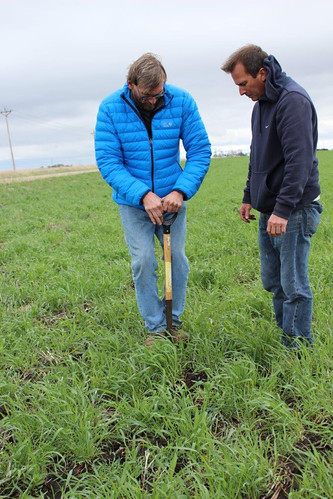
Brian Parkinson grows cereal rye and other varieties of cover crops near Milan, Ill. Parkinson works with NRCS District Conservationist Joe Gates to make conservation improvements to his land. Photo courtesy of NRCS.
The mighty Mississippi – it’s a river with a history of romance and enchantment. Native Americans depended on the Mississippi River for food and water, and world explorers came in search of its riches.
Over time, farmsteads dotted the land, and small towns grew to large cities. Today, we see the fruits of our labor as industry, commerce and agriculture continue to thrive in the basin. But those successes come with environmental challenges. Many of the basin’s waterways suffer from poor water quality.
To address those issues, the USDA’s Natural Resources Conservation Service (NRCS) works side-by-side with farmers to make conservation improvements to their land that clean and conserve water, boost the quality of soil and air and enhance habitat for wildlife. You can view some of the progress of Mississippi River-area farmers in this video “Farming the Upriver.”
NRCS has identified the basin as a top priority because of high levels of nutrients and sediment found in many waterways, which affect the health of the Mississippi River as well as the Gulf of Mexico downstream.
In 2010, NRCS launched the Mississippi River Basin Healthy Watersheds Initiative (MRBI), accelerating conservation in priority watersheds throughout the basin. Since its launch, farmers have worked with NRCS to implement science-based practices on more than 1 million acres.
Meet Brian Parkinson, an Illinois farmer who uses no-till, plants cover crops and installs buffer strips to keep nutrients and soil on fields and out of waterways.
“The idea of the saturated buffer strip is to intercept the water that is carrying nutrients that come from the fields and allows them to be taken up by the prairie grass that we planted in the buffer strip before it hits the creek,” Parkinson said of one of the conservation practices in place on his farm. “We’re trying to stop the problem here in my field before it becomes a problem for anyone else downstream.”
Same goes for David Petersen, a dairy farmer in Iowa. He captures and safely stores the cattle’s waste in an underground bin, which he then uses to fertilize fields to grow feed.
“He doesn’t want to see that go into that waterway and down into the creek because we know it eventually will get to the Mississippi River and down to the Gulf where it has disastrous consequences,” said John Matz, NRCS district conservationist, who has worked with Petersen to make conservation improvements to his land.
These conservation efforts are working. Watersheds prioritized by MRBI have shown clear successes in helping to improve water quality. For example, two stream segments in the St. Francis River watershed in Arkansas have been removed from the U.S. Environmental Protection Agency’s list of impaired streams.
MRBI is now in its sixth year, and NRCS plans to continue its work with partners and landowners in the 13-state area.
The more farmers that say, “Hey, I can improve my operations for the good of water quality,” the larger the impact will be downstream.
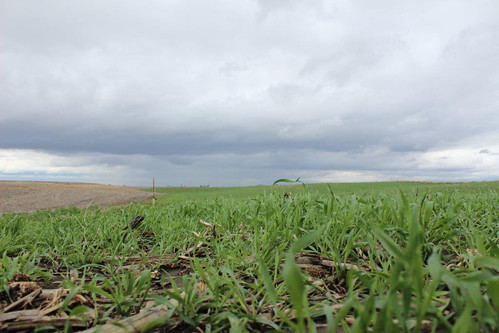
Cover crops and no-till help Brian Parkinson improve soil health and curb soil erosion. Photo courtesy of NRCS.


