Search This Blog

Friday, March 25, 2022

EPA grants $32 million to Oregon for drinking water, wastewater infrastructure improvements

 EPA Press Office:


EPA grants $32 million to Oregon for drinking water, wastewater infrastructure improvements

State estimates $70 million for wastewater, $70 million for drinking water projects

SEATTLE -- The U.S. Environmental Protection Agency announced it will help fund Oregon’s $70 million plan for key drinking water projects and $70 million plan to improve wastewater infrastructure.
 
In addition to this round of funding, Congress recently passed the Infrastructure Investment and Jobs Act /Bipartisan Infrastructure Law, which will inject another $92 million into Oregon’s two State Revolving Fund programs in 2022.
 
“Clean and safe water is a basic right, but at the same time something we can’t take for granted” said EPA Region 10’s Water Division Director Dan Opalski. “EPA is proud to invest along with our state partners in these projects that will benefit the health of Oregon’s communities.”
 
The EPA’s Drinking Water State Revolving Fund program provides below-market rate loans for the construction of drinking water treatment facilities and other projects and activities vital to ensuring the delivery of clean and safe drinking water at the tap. The loans help communities keep water rates more affordable while addressing local water infrastructure challenges. Similarly, the Clean Water State Revolving Fund helps states fund large wastewater and other water quality projects.
 
Some of the projects to be funded in the state’s 2021-2022 drinking water plan include:
  • $20,000 for the Round Lake Mobile Home Park feasibility study. This project will identify solutions for water system improvements as well as evaluate the adequacy of long-term water supply for this water system.
  • $19,587 to the city of Gates to replace outdated monitoring equipment and alleviate drinking water quality concerns. Gates will also receive $30,000 from Oregon’s DWSRF Drinking Water Source Protection Fund (DWSPF).  These funds will be used to install temporary monitoring equipment, collect samples, and then analyze and share the data to gain a better understanding of post fire impacts on sources of drinking water.  
  • $100,000 to the Rhododendron Water Association for the purchase of a Riparian Management Area and conservation easement on privately owned timber land to protect the system’s drinking water intake from clear-cut logging activity that could have created water quality issues.  
  • $862,145 to Crescent Water Supply and Improvement District will be used for water master planning and well construction.  
  • $1,660,761 to Christmas Valley Domestic Water Supply District for distribution system improvements. The project will result in replacement of approximately three miles of distribution piping to help address water loss due to aging steel distribution pipe failure.   
The state’s list of wastewater projects to be funded include:
  • $30,056,061 to the city of Sweet Home to help the wastewater treatment plant achieve Clean Water Act compliance. The city of Sweet Home project affects a disadvantaged community. 
  • $1,2500,000 to the city of Bend to address city climate action goals through a collections system master plan update.
  • $2,000,000 to the Lone Pine Irrigation District for modernization of the of the irrigation system. The Lone Pine Irrigation District qualifies as a disadvantaged community.
  • $2,313,231 to the city of Madras to a wastewater collection expansion, allowing residences currently on septic to connect to the city sewer. The city of Madras qualifies as a disadvantaged community. 
 
The sources of funding for Oregon’s Drinking Water State Revolving Fund Intended Use Plan include a $14.4 million grant from EPA, $2.8 million in state matching funds, along with $58 million in interest earnings and repayments from previous DWSRF loans.  
 
Similarly, the sources of funding for Oregon’s Clean Water State Revolving Fund Intended Use Plan include a $17.9 million grant from EPA, $3.6 million in state matching funds, along with $52.5 million in interest earnings and repayments from previous CWSRF loans.
 
A full list of Oregon’s DWSRF projects to be funded can be found at: 
 
A full list of Oregon’s CWSRF projects to be funded can be found at: 
 
For more information about EPA’s State Revolving Fund Programs go to: 

Thursday, March 24, 2022

New EPA Tool Provides the Public with Customized Updates on Local Enforcement and Compliance Activities

 EPA Press Release:


New EPA Tool Provides the Public with Customized Updates on Local Enforcement and Compliance Activities

WASHINGTON (March 22, 2022) – Today, EPA announced the release of a new web tool, called “ECHO Notify,” that empowers members of the public to stay informed about important environmental enforcement and compliance activities in their communities.  Through ECHO Notify, users can signup to receive weekly emails when new information is available within the selected geographic area, such as when a violation or enforcement action has taken place at a nearby facility. 

“EPA is committed to empowering communities with the information they need to understand and make informed decisions about their health and the environment,” said EPA Administrator Michael S. Regan.  “We’ve also seen that increased transparency leads to stronger deterrence of environmental violations. As more people play an active role in protecting their neighborhoods from pollution, EPA has developed ECHO Notify so that finding updates on environmental enforcement and compliance activities is as easy as checking your email.”

ECHO Notify provides information on all EPA enforcement and compliance activities as well as activities of state and local governments under the Clean Air Act, Clean Water Act, Resource Conservation and Recovery Act, and the Safe Drinking Water Act.  

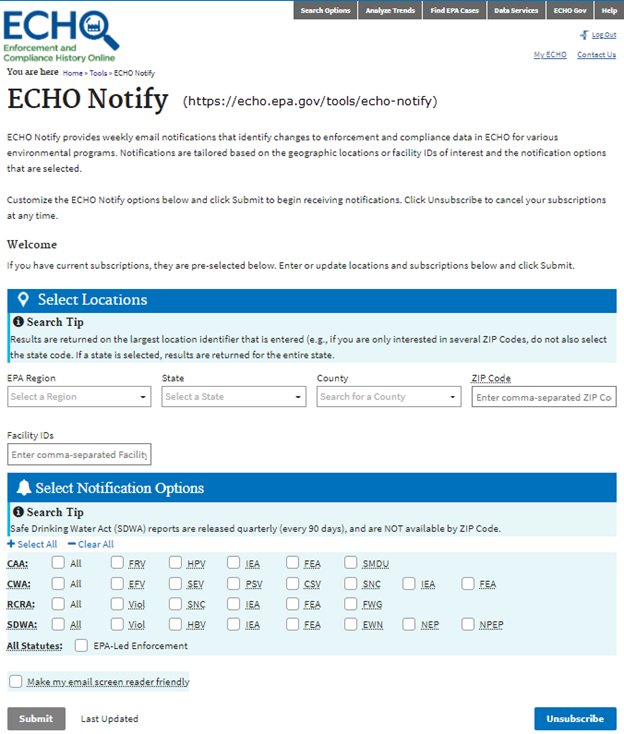
You can find ECHO Notify on EPA’s website at ECHO Notify, as shown below. 


This is a screenshot of ECHO Notify on EPA's website. 


Visitors to the ECHO Notify homepage who wish to receive email updates only need to take a few simple steps: 

  • Create an account, if you don’t have one already;
  • Select a geographic area and/or facility ID(s);
  • Choose the type of compliance and enforcement information of interest;
  • Enter an email address; and
  • Click “subscribe.”

Once subscribed, the user will receive an automated email (typically on Sunday) containing new information from the prior weeklong period. If no new information is available, no email will be sent. Email notifications include links for users to view additional information on ECHO, including a link to each facility’s Detailed Facility Report. Users can easily update their notification selections or unsubscribe at any time.

EPA has prepared a video that provides an overview of ECHO Notify and explains how to use it.  The video can be seen here, ECHO Tutorial: Intro to ECHO Notify


For further information: EPA Press Office, press@epa.gov

New interactive tool details investments made in communities across the country.

 EPA News Release:


EPA WIFIA Annual Report Celebrates over $5 Billion in Water Infrastructure Loans

New interactive tool details investments made in communities across the country.

WASHINGTON (March 24, 2022) – Today, the U.S. Environmental Protection Agency (EPA) released the 2021 Water Infrastructure Finance and Innovation Act (WIFIA) Annual Report. The report highlights the program’s 2021 investments in water infrastructure to protect public health and the environment, create good-paying jobs, and save communities money over alternative financing options.

“The WIFIA program has been an incredible success, providing more than $5 billion in water infrastructure funding in 2021 to save communities $1.5 billion while creating nearly 40,000 jobs,” said EPA Administrator Michael S. Regan. “The WIFIA program, the Bipartisan Infrastructure Law and the agency’s other water infrastructure funding programs are building a better America by securing clean and safe water for all.”

In 2021, the WIFIA program closed 31 loans totaling over $5 billion to support nearly $12 billion in water infrastructure projects. At the same time, borrowers saved $1.5 billion and created nearly 40,000 jobs. The WIFIA program continues to broaden its reach by increasing the number of loans to borrowers with lower-rated credit, small communities, and underserved communities. Looking forward, the program has nearly 90 projects requesting over $14 billion in funding.

Additionally, to provide real time information about the WIFIA program, EPA is launching the WIFIA Fund Facts dashboard. This interactive web-based tool includes graphics and facts about closed and pending loans. Users can filter the data to get information by loan size, project type, geographic location, and loan status.

For more information about the WIFIA program, visit: WIFIA.

To access the WIFIA Fund Facts dashboard, visit: WIFIA Fund Facts Dashboard.

Background 

Established by the Water Infrastructure Finance and Innovation Act of 2014, the WIFIA program is a federal loan and guarantee program administered by EPA. WIFIA’s aim is to accelerate investment in the nation’s water infrastructure by providing long-term, low-cost supplemental credit assistance for regionally and nationally significant projects. Since inception, EPA has closed 72 WIFIA loans that are investing approximately $13.3 billion in communities across the country to protect public health and the environment while creating over 81,000 jobs.

The WIFIA program has an active pipeline of pending applications for projects that will result in billions of dollars in water infrastructure investment and thousands of jobs.

Tuesday, March 22, 2022

EPA Issues Emergency Orders to Four Mobile Home Parks in Thermal, Calif., to Ensure Drinking Water is Safe

 EPA News Release:


EPA Issues Emergency Orders to Four Mobile Home Parks in Thermal, Calif., to Ensure Drinking Water is Safe

THERMAL (March. 22, 2022) - The U.S. Environmental Protection Agency (EPA) has issued emergency orders under the Safe Drinking Water Act (SDWA) to four mobile home park water systems, requiring the mobile home park owners to comply with federal drinking water safety requirements and to identify and correct problems with their drinking water systems that present a danger to residents. The mobile home parks -- Arellano Mobile Home Park, Castro Ranch, Gonzalez Mobile Home Park, and Sandoval Mobile Home Park -- are all located on the Torres Martinez Desert Cahuilla Indians’ Reservation in California.  None of the water systems were previously registered with EPA and will now be required to comply with SDWA regulations.

"These emergency orders support EPA’s larger effort in the Eastern Coachella Valley to ensure all drinking water systems comply with SDWA and provide safe drinking water,” said Martha Guzman, EPA’s Regional Administrator for the Pacific Southwest. “Mobile home park owners and all levels of government must protect the health of residents and comply with federal law.”

Today’s announcement applies to four separate water systems, which EPA inspected and sampled in November 2021. The systems' current source of drinking water is groundwater that has naturally occurring arsenic. Arsenic is a known carcinogen and drinking high levels over many years can increase the chance of lung, bladder, and skin cancers, as well as heart disease, diabetes, and neurological damage. The regulatory Maximum Contaminant Level (MCL) for arsenic in drinking water is 10 parts per billion (ppb).

Based on the sample results, all the systems are currently serving water that exceed the arsenic MCL:

Arellano Mobile Home Park: The system serves approximately 26 residents and has arsenic levels ranging from 14 ppb to 16 ppb. 

Castro Ranch: The system serves approximately 40 residents and has arsenic levels ranging from 18 ppb to 19 ppb. 

Gonzalez Mobile Home Park: The system serves approximately 40 residents and has arsenic levels ranging from 28 ppb to 29 ppb.

Sandoval Mobile Home Park: The water system serves approximately 37 residents and has arsenic levels ranging from 15 ppb to 17 ppb.

Under the terms of EPA’s emergency orders, the owners of Arellano Mobile Home Park, Castro Ranch, Gonzalez Mobile Home Park, and Sandoval Mobile Home Park are required to:

  • provide at least one gallon of drinking water per person per day at no cost for every individual served by the system;
  • submit and implement an EPA-approved compliance plan to reduce arsenic below the MCL; and
  • properly monitor the systems’ water and report findings to EPA.


EPA will continue to oversee the systems’ efforts to follow SDWA requirements and may levy civil penalties if the park owners fail to meet the compliance provisions in the emergency orders.

The Torres Martinez Desert Cahuilla Indians have no direct control or ownership of the water systems. EPA works closely with the Tribe and has consulted their leadership about the violations.

For more information on EPA's drinking water program, please visit: https://www.epa.gov/ground-water-and-drinking-water.

New EPA Tool Provides the Public with Customized Updates on Local Enforcement and Compliance Activities

 EPA Press Office:


New EPA Tool Provides the Public with Customized Updates on Local Enforcement and Compliance Activities

WASHINGTON (March 22, 2022) – Today, EPA announced the release of a new web tool, called “ECHO Notify,” that empowers members of the public to stay informed about important environmental enforcement and compliance activities in their communities.  Through ECHO Notify, users can signup to receive weekly emails when new information is available within the selected geographic area, such as when a violation or enforcement action has taken place at a nearby facility. 

“EPA is committed to empowering communities with the information they need to understand and make informed decisions about their health and the environment,” said EPA Administrator Michael S. Regan.  “We’ve also seen that increased transparency leads to stronger deterrence of environmental violations. As more people play an active role in protecting their neighborhoods from pollution, EPA has developed ECHO Notify so that finding updates on environmental enforcement and compliance activities is as easy as checking your email.”

ECHO Notify provides information on all EPA enforcement and compliance activities as well as activities of state and local governments under the Clean Air Act, Clean Water Act, Resource Conservation and Recovery Act, and the Safe Drinking Water Act.  

You can find ECHO Notify on EPA’s website at ECHO Notify, as shown below. 

This is a screenshot of ECHO Notify on EPA's website

Visitors to the ECHO Notify homepage who wish to receive email updates only need to take a few simple steps: 

  • Create an account, if you don’t have one already;
  • Select a geographic area and/or facility ID(s);
  • Choose the type of compliance and enforcement information of interest;
  • Enter an email address; and
  • Click “subscribe.”

Once subscribed, the user will receive an automated email (typically on Sunday) containing new information from the prior weeklong period. If no new information is available, no email will be sent. Email notifications include links for users to view additional information on ECHO, including a link to each facility’s Detailed Facility Report. Users can easily update their notification selections or unsubscribe at any time.

EPA has prepared a video that provides an overview of ECHO Notify and explains how to use it.  The video can be seen here, ECHO Tutorial: Intro to ECHO NotifyEXITEXIT EPA WEBSITE.

Statement by EPA Administrator Michael S. Regan on National Agriculture Day

 EPA Press Office:


Statement by EPA Administrator Michael S. Regan on National Agriculture Day

WASHINGTON (March 22, 2022) — In celebration of National Agriculture Day, EPA Administrator Michael S. Regan issued the following statement:

“The contributions of America’s farmers and ranchers to our economy, our national security and our daily lives are truly indispensable. Despite the increasing impacts of climate change, supply chain disruptions from the pandemic, and recent volatility in markets, our agricultural producers work tirelessly to put food on our tables. I am so grateful for those who wake up every day to ensure our country and the world has an abundant supply of food, feed, fuel, and fiber and I look forward to our continued partnership with the agricultural community to strengthen the productivity and resilience of our system while delivering on our mission to protect human health and the environment.

In support of this mission, I am pleased to announce that EPA has recently rechartered the Agency’s Farm, Ranch & Rural Communities Advisory Committee, which provides independent advice and recommendations on environmental issues important to our agriculture and rural communities. America’s farmers and ranchers find themselves on the front lines of the climate crisis, facing increasing impacts from extreme weather events like severe storms, widespread flooding, prolonged drought, and more frequent wildfires. That’s why today, I am issuing a new charge topic for the FRRCC to evaluate the Agency’s policies and programs at the intersection of agriculture and climate change. For the next two years, I am asking the committee to consider how EPA’s tools and programs can best advance the U.S. agriculture sector’s climate mitigation and adaptation goals, ensuring EPA can support farmers and ranchers in their efforts to reduce emissions and accelerate a more resilient food and agriculture system.”

For more information on EPA’s partnership with the agricultural community, click here.

EPA Seeks More Information from New Owners of Refinery on St. Croix to Determine Possible Permitting Requirements

 EPA Press Office:


EPA Seeks More Information from New Owners of Refinery on St. Croix to Determine Possible Permitting Requirements

Contact: Elias Rodriguez, (212) 637-3664, rodriguez.elias@epa.gov

NEW YORK (March 22, 2022) – The U.S. Environmental Protection Agency (EPA) today sent a letter to West Indies Petroleum Limited (WIPL) and Port Hamilton Refining and Transportation, LLLP (PHRT) – the new owners of the former Limetree Bay refinery on St. Croix – informing them that, based on the information currently available to EPA, there are strong indicators to suggest that the refinery must obtain a Prevention of Significant Deterioration (PSD) permit prior to any potential startup of refinery operations.

In the letter, EPA asks for additional information regarding past and future changes to processes and emission units at the refinery. The information will enable the Agency to evaluate this issue further, before making a final determination regarding the need for a PSD permit.

“As EPA continues to obtain additional information to reach a final decision on the need for this particular permit, we remain committed to ensuring that any potential restart of this facility would occur safely and in accordance with environmental laws,” said Lisa F. Garcia, EPA Regional Administrator. “Given the concerning incidents at this facility that previously endangered the health of the people who live and work in surrounding communities, we will carefully review the information we receive and any new plans before determining our next steps in the permitting process.”

A PSD permit applies to new major air pollution sources or major modifications at existing sources that result in an increase of certain pollutant emissions (for example, particulate matter, sulfur dioxide, or nitrogen oxide) where the area in which the source is located attains or meets EPA’s national air quality health standards. In its letter, EPA poses a series of questions to the new owners, seeking answers that will help determine whether the refinery needs to obtain a PSD permit. 

The purpose of the PSD permit program is to protect public health and welfare and ensure that new air pollution sources or changes at existing air pollution sources do not degrade air quality. PSD permits are complex and specific to a given facility. In general, they require the facility to meet emissions limits that would be achieved by using the best available air pollution control technology and perform an air quality impact analysis, with an opportunity for public review and comment. If such a permit is required for the refinery on St. Croix, it must be obtained prior to startup of that facility.

In May 2021, EPA ordered the owners at the time, Limetree Bay Refining, LLC and Limetree Bay Terminals, LLC, to stop refinery operations following a series of excess emissions incidents that included exceedances of limits for sulfur dioxide and hydrogen sulfide, endangering the health and welfare of nearby communities. In response to these incidents, EPA ordered the refinery to pause all operations until the agency could be assured that this facility can operate safely and in accordance with laws that protect public health.

EPA’s letter to West Indies Petroleum Limited and Port Hamilton Refining and Transportation, LLLP is available at: https://www.epa.gov/vi/refinery-st-croix-us-virgin-islands

Follow EPA Region 2 on Twitter at http://twitter.com/eparegion2 and visit our Facebook page, http://facebook.com/eparegion2

22-024