Search This Blog

Thursday, September 9, 2021

EPA Takes Action to Address Risks to Public Health by Proposing to Add Ochoa Fertilizer Co. in Guánica, Puerto Rico to the National Priorities List

 U.S. EPA News Release:


EPA Takes Action to Address Risks to Public Health by Proposing to Add Ochoa Fertilizer Co. in Guánica, Puerto Rico to the National Priorities List


Contact: Brenda Reyes, 787-977-5869, reyes.brenda@epa.go

               Stephen McBay, (212) 637-3672, mcbay.stephen@epa.gov

NEW YORK (September 8, 2021) – Today, the U.S. Environmental Protection Agency (EPA) announced that it is adding four sites to the National Priorities List (NPL) where releases of contamination pose significant human health and environmental risks. EPA is also proposing to add another 13 sites including Ochoa Fertilizer Co. in Guánica, Puerto Rico and is withdrawing a previously proposed site, following the Agency’s science-based determination that placing the site on the NPL is not needed to protect human health and the environment.

With this Superfund NPL update, the Biden-Harris Administration is demonstrating a commitment to updating the NPL twice a year. By pledging to add sites more regularly to the NPL, EPA is taking action to protect the health of communities across the country while cleaning up and returning blighted properties to safe and productive reuse in areas where environmental cleanup and jobs are needed most.

“EPA recognizes that no community deserves to have contaminated sites near where they live, work, pray, and go to school.  By adding sites to the Superfund NPL, we are helping to ensure that more communities living near the nation’s most serious uncontrolled or abandoned releases of contamination have the protection they deserve,” said EPA Administrator Michael S. Regan.  “The Biden-Harris Administration is committed to increasing funding and working with Congress on the bipartisan infrastructure deal to provide the Superfund Program with the resources it needs to address a backlog of sites awaiting cleanup, as well as additional sites in need of cleanup.”

The Ochoa Fertilizer Co. site includes a fertilizer manufacturing facility in Guánica, Puerto Rico. The facility consists of two parcels -- a 13-acre western lot along Guánica Bay and a 112-acre eastern lot that is within 500 feet of the Bay. Former operators of the facility manufactured ammonia, ammonium sulfate and sulfuric acid beginning in the 1950s and stopped operating in 1968. Fertilizer manufacturing on the 13-acre lot has continued to the present day. Past operations at the site resulted in releases of untreated waste at and from the eastern lot, contaminating soil and causing environmental degradation to Guánica Bay. There is a potential risk of exposure to nearby residents from soil contaminated with mercury, lead, and polychlorinated biphenyls (PCBs).

In addition, previous studies from the National Oceanographic and Atmospheric Administration show that elevated levels of contamination from the site could pose a threat to corals, fish, and aquatic life. Studies from the University of Miami also show elevated levels of PCBs in bay sediment, fish samples, and blood samples from Guánica residents. The Puerto Rico Department of Natural and Environmental Resources supports the inclusion of the site to the Superfund NPL.

Background

The NPL includes the nation’s most serious uncontrolled or abandoned releases of contamination. The list serves as the basis for prioritizing EPA Superfund cleanup funding and enforcement actions. Only releases at sites included on the NPL are eligible to receive federal funding for long-term, permanent cleanup.

EPA proposes sites to the NPL based on a scientific determination of risks to people and the environment, consistent with the Comprehensive Environmental Response, Compensation, and Liability Act and the National Oil and Hazardous Substances Pollution Contingency Plan. 

Superfund cleanups provide health and economic benefits to communities. The program is credited for significant reductions in both birth defects and blood-lead levels among children living near sites, and research has shown residential property values increase up to 24 percent within three miles of sites after cleanup.

Further, thanks to Superfund cleanups, communities are now using previously blighted properties for a wide range of purposes, including retail businesses, office space, public parks, residences, warehouses, and solar power generation. As of 2020, EPA has collected economic data on 632 Superfund sites, finding 9,900 businesses in operation, 227,000 people employed, $16.3 billion in employee-earned income, and $63.3 billion in business-generated sales.

For information about Superfund and the NPL, please visit: https://www.epa.gov/superfund

For Federal Register notices and supporting documents for NPL and proposed sites, please visit: https://www.epa.gov/superfund/current-npl-updates-new-proposed-npl-sites-and-new-npl-sites

For site updates, visit: www.epa.gov/superfund/Ochoa-Fertilizer

Follow EPA Region 2 on Twitter at http://twitter.com/eparegion2 and visit our Facebook page, http://facebook.com/eparegion2

21.0056

EPA Proposes Adding Bear Creek Sediments Site to Superfund List

 U.S. EPA News Release:


EPA Proposes Adding Bear Creek Sediments Site to Superfund List

PHILADELPHIA (Sept. 8, 2021) – The U.S. Environmental Protection Agency proposed adding the Bear Creek Sediments site in Baltimore County, Maryland, today to the Superfund National Priorities List (NPL). The NPL is the list of hazardous waste sites in the United States eligible for remedial cleanup action financed under the federal Superfund program.

With this Superfund NPL update, the Biden-Harris Administration is demonstrating a commitment to updating the NPL twice a year. By pledging to add sites more regularly to the NPL, EPA is taking action to protect the health of communities across the country while cleaning up and returning blighted properties to safe and productive reuse in areas where environmental cleanup and jobs are needed most.

The Bear Creek Sediments site consists of a minimum of 60 acres of contaminated sediments in the waters of Bear Creek, near its confluence with the Patapsco River along the northwestern shore of the Sparrows Point peninsula, six miles southeast of downtown Baltimore.

Bear Creek is a tidal surface water body adjacent to the 3,100-acre Sparrows Point Peninsula, which was the site of steelmaking and shipbuilding industries. The Bethlehem Steel Corporation (BSC) was the primary owner and operator for much of the Sparrows Point operational history between 1887 and 2013.

More than 100 years of steelmaking left behind a legacy of contamination on both land and in the waters surrounding the Peninsula. Sediments in Bear Creek were contaminated primarily by the migration of hazardous substances from the steel making process and the effluent discharges from process wastewater and stormwater that discharged to Bear Creek.

“If finalized, this proposed listing will enable us to continue our work with our strong partnership with the state of Maryland, to investigate, and to clean up the contamination of the Bear Creek Sediments Site,” said EPA Mid-Atlantic Acting Regional Administrator Diana Esher. “We determined the site needs to be placed on the NPL because the Bear Creek sediments off-shore of Sparrows Point are contaminated with hazardous substances, and EPA resources are necessary to provide long-term cleanup at this time.”

People are exposed to contamination as they use the waters of Bear Creek for recreational activity and fishing/crabbing. The Maryland Department of the Environment (MDE) has issued a fish consumption advisory for 10 species of fish and the blue crab caught in the Patapsco River-Baltimore Harbor Watershed due to the presence of polychlorinated biphenyls or PCBs. 

Land sources of contamination are being addressed by the current owner of the facility under MDE and EPA oversight through other cleanup programs and are not included as part of this site. The facility has undergone extensive removal of contamination and capping to ensure contaminants no longer have the potential to migrate into Bear Creek.

To date, there have been no cleanup activities associated with the offshore sediments in Bear Creek. On May 18, EPA received a letter of support for placing this site on the NPL from the state of Maryland.

When EPA proposes to add a site to the NPL, the Agency publishes the proposed rule in the Federal Register and notifies the community through the local media so interested members of the community can comment on the proposal.  

There will be a 60-day comment period from September 9 – November 8, 2021, where the public can comment on the listing of the Bear Creek Sediments Site. EPA will consider those comments in the final decision to list the site on the NPL.

If, after the formal comment period, the site still qualifies for cleanup under Superfund, the Agency will publish a final rule in the Federal Register and Bear Creek Sediments will become a Superfund Site.  EPA then conducts a more comprehensive investigation of the Superfund Site, called a Remedial Investigation/Feasibility Study. 

More information on the public comment process of listing sites can be found here.  

All comments received will be treated equally. Comments can be submitted one of two ways:   

Online:  http://www.regulations.gov  

               Search for “EPA-HQ-OLEM-2021-0458” 
 

Mail:        U.S. Environmental Protection Agency  

                EPA Docket Center  

                 Docket # EPA-HQ-OLEM-2021-0458 

                Mailcode 28221T  

                1200 Pennsylvania Avenue NW  

                 Washington, DC 20460   


Background on the Superfund Program

Superfund, which Congress established in 1980, investigates and cleans up hazardous waste sites. The Superfund law directs EPA to update the NPL annually. Only sites added to the NPL are eligible to receive federal funding for long-term cleanup.

EPA adds sites to the NPL when contamination threatens human health and the environment. EPA deletes sites from the NPL once all response actions are complete and all cleanup goals have been achieved. EPA typically initiates Superfund involvement because states, tribes or citizens ask for EPA’s help. EPA may also find contamination during its own investigations.

For information about Superfund and the NPL: http://www.epa.gov/superfund

EPA Takes Action to Address Risks to Public Health by Adding Pioneer Metal Finishing Inc. in Franklinville, New Jersey to the National Priorities List

 U.S. EPA News Release:


EPA Takes Action to Address Risks to Public Health by Adding Pioneer Metal Finishing Inc. in Franklinville, New Jersey to the National Priorities List


Contact: Stephen McBay, (212) 637-3672, mcbay.stephen@epa.gov

NEW YORK (September 8, 2021) – Today, the U.S. Environmental Protection Agency (EPA) announced that it is adding four sites to the National Priorities List (NPL) including Pioneer Metal Finishing Inc. in Franklinville, New Jersey where releases of contamination pose significant human health and environmental risks. EPA is also proposing to add another 13 sites and is withdrawing a previously proposed site, following the Agency’s science-based determination that placing the site on the NPL is not needed to protect human health and the environment.

With this Superfund NPL update, the Biden-Harris Administration is demonstrating a commitment to updating the NPL twice a year. By pledging to add sites more regularly to the NPL, EPA is taking action to protect the health of communities across the country while cleaning up and returning blighted properties to safe and productive reuse in areas where environmental cleanup and jobs are needed most.

“EPA recognizes that no community deserves to have contaminated sites near where they live, work, pray, and go to school.  By adding sites to the Superfund NPL, we are helping to ensure that more communities living near the nation’s most serious uncontrolled or abandoned releases of contamination have the protection they deserve,” said EPA Administrator Michael S. Regan.  “The Biden-Harris Administration is committed to increasing funding and working with Congress on the bipartisan infrastructure deal to provide the Superfund Program with the resources it needs to address a backlog of sites awaiting cleanup, as well as additional sites in need of cleanup.”

Pioneer Metal Finishing Inc. is a former electroplating facility in Franklinville, NJ. It began operations in the mid-1950s and discharged untreated waste from the facility into an adjacent wetland until the mid-to-late-1970s. The untreated wastes consisted of metallic salts and process sludge. Around 2005, the facility stopped electroplating, but it continues powder coating operations. Samples taken by EPA and Pioneer Metal Finishing Inc. show that soil near the facility and sediment within the adjacent wetland are contaminated with chromium, copper, and nickel at levels that could pose a threat to people’s health and the environment. The soil is also contaminated with polychlorinated biphenyls (PCBs). The New Jersey Department of Environmental Protection (NJDEP) supports the inclusion of the site to the Superfund NPL.

Background

The NPL includes the nation’s most serious uncontrolled or abandoned releases of contamination. The list serves as the basis for prioritizing EPA Superfund cleanup funding and enforcement actions. Only releases at sites included on the NPL are eligible to receive federal funding for long-term, permanent cleanup.

EPA proposes sites to the NPL based on a scientific determination of risks to people and the environment, consistent with the Comprehensive Environmental Response, Compensation, and Liability Act and the National Oil and Hazardous Substances Pollution Contingency Plan. 

Superfund cleanups provide health and economic benefits to communities. The program is credited for significant reductions in both birth defects and blood-lead levels among children living near sites, and research has shown residential property values increase up to 24 percent within three miles of sites after cleanup.

Further, thanks to Superfund cleanups, communities are now using previously blighted properties for a wide range of purposes, including retail businesses, office space, public parks, residences, warehouses, and solar power generation. As of 2020, EPA has collected economic data on 632 Superfund sites, finding 9,900 businesses in operation, 227,000 people employed, $16.3 billion in employee-earned income, and $63.3 billion in business-generated sales.

For information about Superfund and the NPL, please visit: https://www.epa.gov/superfund

For Federal Register notices and supporting documents for NPL and proposed sites, please visit: https://www.epa.gov/superfund/current-npl-updates-new-proposed-npl-sites-and-new-npl-sites

For site background, visit: www.epa.gov/superfund/Pioneer-Metal-Finishing

Follow EPA Region 2 on Twitter at http://twitter.com/eparegion2 and visit our Facebook page, http://facebook.com/eparegion2

21-058

EPA Takes Action to Address Risks to Public Health by Proposing to Add Meeker Avenue Plume, Brooklyn, New York to the National Priorities List

 U.S. EPA News Release:


EPA Takes Action to Address Risks to Public Health by Proposing to Add Meeker Avenue Plume, Brooklyn, New York to the National Priorities List

Contact: Stephen McBay, (212) 637-3672, mcbay.stephen@epa.gov

NEW YORK (September 8, 2021) – Today, the U.S. Environmental Protection Agency (EPA) announced that it is adding four sites to the National Priorities List (NPL) where releases of contamination pose significant human health and environmental risks. EPA is also proposing to add another 13 sites including Meeker Avenue Plume, Brooklyn, New York and is withdrawing a previously proposed site, following the Agency’s science-based determination that placing the site on the NPL is not needed to protect human health and the environment.

With this Superfund NPL update, the Biden-Harris Administration is demonstrating a commitment to updating the NPL twice a year. By pledging to add sites more regularly to the NPL, EPA is taking action to protect the health of communities across the country while cleaning up and returning blighted properties to safe and productive reuse in areas where environmental cleanup and jobs are needed most.

“EPA recognizes that no community deserves to have contaminated sites near where they live, work, pray, and go to school.  By adding sites to the Superfund NPL, we are helping to ensure that more communities living near the nation’s most serious uncontrolled or abandoned releases of contamination have the protection they deserve,” said EPA Administrator Michael S. Regan.  “The Biden-Harris Administration is committed to increasing funding and working with Congress on the bipartisan infrastructure deal to provide the Superfund Program with the resources it needs to address a backlog of sites awaiting cleanup, as well as additional sites in need of cleanup.”

EPA is proposing to list this site after close consultation with the New York State Department of Environmental Conservation (NYSDEC), which discovered a plume at the Meeker Avenue site during the investigation and remediation of an adjacent petroleum groundwater contamination location. This area of Brooklyn housed historical petroleum refining and storage operations along the banks of Newtown Creek. Chlorinated volatile organic compounds (CVOCs) were found in subsurface soil and groundwater outside of the historic petroleum spill area, prompting NYSDEC to conduct several environmental investigations.

NYSDEC’s previous and ongoing work at this site includes investigations that found contaminants of CVOCs, including tetrachloroethylene (PCE) and trichloroethylene (TCE), in the subsurface and indoor air of occupied residential and commercial structures above the groundwater contaminant plume. Indoor air contamination from vapor intrusion presents a potential health risk. NYSDEC has taken measures to mitigate exposures by installing sub-slab depressurization systems, which direct hazardous vapors in the soil to the exterior of the building. NYSDEC continues to conduct additional investigations to identify sources of contamination and continues to offer sub-slab and indoor air sampling to property owners within the boundary of the Meeker Avenue site. The State of New York supports the inclusion of the site on the Superfund NPL.

Background

The NPL includes the nation’s most serious uncontrolled or abandoned releases of contamination. The list serves as the basis for prioritizing EPA Superfund cleanup funding and enforcement actions. Only releases at sites included on the NPL are eligible to receive federal funding for long-term, permanent cleanup.

EPA proposes sites to the NPL based on a scientific determination of risks to people and the environment, consistent with the Comprehensive Environmental Response, Compensation, and Liability Act and the National Oil and Hazardous Substances Pollution Contingency Plan. 

Superfund cleanups provide health and economic benefits to communities. The program is credited for significant reductions in both birth defects and blood-lead levels among children living near sites, and research has shown residential property values increase up to 24 percent within three miles of sites after cleanup.

Further, thanks to Superfund cleanups, communities are now using previously blighted properties for a wide range of purposes, including retail businesses, office space, public parks, residences, warehouses, and solar power generation. As of 2020, EPA has collected economic data on 632 Superfund sites, finding 9,900 businesses in operation, 227,000 people employed, $16.3 billion in employee-earned income, and $63.3 billion in business-generated sales.

For information about Superfund and the NPL, please visit: https://www.epa.gov/superfund

For Federal Register notices and supporting documents for NPL and proposed sites, please visit: https://www.epa.gov/superfund/current-npl-updates-new-proposed-npl-sites-and-new-npl-sites

For site background, visit: www.epa.gov/superfund/Meeker-Avenue-Plume

Follow EPA Region 2 on Twitter at http://twitter.com/eparegion2 and visit our Facebook page, http://facebook.com/eparegion2

21-057

Monday, September 6, 2021

EPA Tools for Communities Cleaning Up after Hurricane Ida

 U.S. EPA Region 6 News Release:


EPA Tools for Communities Cleaning Up after Hurricane Ida


Media contacts: R6Press@epa.gov or Press@epa.gov

DALLAS – (Sept. 4, 2021) The U.S. Environmental Protection Agency (EPA) reminds communities, families, and business owners affected by Hurricane Ida to take steps to make storm cleanup as safe and effective as possible. Cleanup activities related to returning to homes and businesses after a disaster can pose significant health and environmental challenges. Use caution to assure that all waste materials are removed and disposed of properly, following local guidelines.

Disasters can generate tons of debris, including building rubble, trees and plants, personal property, and household hazardous wastes. How a community manages disaster debris depends on the debris generated and the waste management options available. EPA offers several resources and tips for managing debris during storm cleanup.

Maintain personal safety

Always wear proper safety equipment, such as goggles, an N95 respirator mask, and gloves when handling debris. Be on the alert for leaking containers and reactive household chemicals, such as caustic drain cleaners or chlorine bleach. Clean up and discard chemicals separately, even if you know what they are. Use caution when disturbing building materials to prevent physical injury or other health effects, as they may contain hazardous materials such as asbestos that, when carried by the air, can be inhaled and cause adverse health effects. If you suspect asbestos-containing materials may be present, the materials should not be disturbed.

Separate wastes by type

Storm damage creates many types of household and building debris. Some of these include building materials, such as drywall, brick, and wood; white goods or appliances, such as refrigerators and washing machines; clothes, furniture, and other personal items; and household hazardous wastes, including paint, cleaners, automotive fluids, batteries, and pesticides. Separating wastes is crucial for communities to effectively manage the large volume of debris following a storm. Please check with your city or local government for specific guidelines on when and how to separate waste. Learn more about types of debris and how to manage them here: https://www.epa.gov/natural-disasters/dealing-debris-and-damaged-buildings#cautions

Be aware of local resources

EPA has developed this interactive mapping tool of 12 types of recyclers and landfills that manage disaster debris. This tool provides information and locations of over 20,000 facilities capable of managing different materials which may be found in disaster debris. The tool was created in EPA Region 5 in 2010 and has expanded to include data for all 50 states, Puerto Rico and US Virgin Islands. Learn more about this tool here:

https://www.epa.gov/large-scale-residential-demolition/disaster-debris-recovery-tool

For more information on how your community can plan for future disaster cleanups, see:

https://www.epa.gov/large-scale-residential-demolition/disaster-debris-planning

EPA continues to support FEMA, state, local, and tribal partners in response to Hurricane Ida. EPA encourages affected communities to continue staying alert for instructions from local authorities. Additional information about EPA’s efforts can be found at https://response.epa.gov/hurricanelaura


Connect with EPA Region 6:

On Facebook: https://www.facebook.com/eparegion6 

On Twitter: https://twitter.com/EPAregion6

About EPA Region 6: https://www.epa.gov/aboutepa/epa-region-6-south-central  

Helpful Public Service Announcements about Emergencies and Disasters in English, Spanish and Vietnamese:

https://www.epa.gov/natural-disasters/public-service-announcements-about-emergencies-and-disasters

https://espanol.epa.gov/espanol/anuncios-de-servicio-publico-sobre-desastres-naturales

https://www.epa.gov/lep/bao#psas

# # #

Saturday, September 4, 2021

EPA Responds to Damage from Storm Remnants of Hurricane Ida in New Jersey and New York

 U.S. EPA News Release:


EPA Responds to Damage from Storm Remnants of Hurricane Ida in New Jersey and New York


NEW YORK (September 2, 2021) – The U.S. Environmental Protection Agency (EPA) Region 2 Office continues to coordinate closely with federal, state and local partners as the Agency responds to the impact of remnants of Hurricane Ida. EPA is supporting New Jersey and New York and is focused on environmental impacts and potential threats to human health caused by the storm, as well as the safety of those in the affected areas.

EPA’s Emergency Operations Center in Washington, D.C. is active and working with FEMA to facilitate efficient interaction with local governments and other federal agencies. EPA Region 2 has begun assessing Superfund sites, oil sites, and chemical facilities in New Jersey and New York as part of our immediate response.

In New Jersey, preliminary assessments of the American Cyanamid Superfund site in Bridgewater, shows significant and wide-spread flooding of the site. Due to its proximity to the Raritan River, this site is known to flood and as a result has a flood management and response plan previously approved by EPA, which has been activated. The plan includes testing and treatment of floodwaters trapped on site, if necessary, prior to discharge. The on-site water treatment plant is operational, and floodwaters can be safely released through floodgates after sampling has taken place. Disposal areas (known as Impoundments) on-site are being monitored by personnel at the site. EPA will ensue that all appropriate response measures are implemented as needed.

EPA is in regular, ongoing communication with our federal, state, tribal, and local partners and the Agency is participating in daily Hurricane Taskforce calls to discuss storm response activities and resource availability. EPA is committed to deploying resources at our disposal to help communities affected by the storm.

Tips to Stay Safe

  • ALWAYS CALL 911 if you are in immediate danger and need emergency help.
  • Communities can report oil, chemical or hazardous substance spills or discharge by calling the EPA National Response Center at 800-424-8802.
  • Avoid exposure to mold and bacteria. Mold and bacteria growth after flood waters recede can be hazardous to your health.
  • Never use a portable generator inside homes, garages, crawlspaces, sheds or similar areas. Deadly levels of carbon monoxide (CO) can quickly build up in these areas and can linger for hours, even after the generator has shut off. Find more information on EPA’s Emergencies and Indoor Air Quality page.
  • Avoid contact with building debris. Debris from damaged homes and buildings can contain hazardous substances, especially in older buildings. Elevated concentrations of airborne asbestos can occur if asbestos-containing materials present in the home are disturbed.
  • EPA has important resources available online in English and Spanish about floodwaters, hazardous debris, household hazardous waste, and other hurricane impacts.

For information and updates, visit: EPA Hurricane Ida

EPA has information on how to Prepare and Respond to Natural Disaster at https://www.epa.gov/natural-disasters

Follow EPA Region 2 on Twitter at http://twitter.com/eparegion2 and visit our Facebook page, http://facebook.com/eparegion2

21-055 

Wednesday, September 1, 2021

EPA Confirms Habitat Improvements at Rochester Embayment Area of Concern in New York

 U.S. EPA News Release:


EPA Confirms Habitat Improvements at Rochester Embayment Area of Concern in New York

11 of 14 Beneficial Uses Now Restored  

https://us.vocuspr.com/Publish/518041/vcsPRAsset_518041_119704_f13975b1-4eef-48cd-b5c0-5df86bb4b658_0.jpg

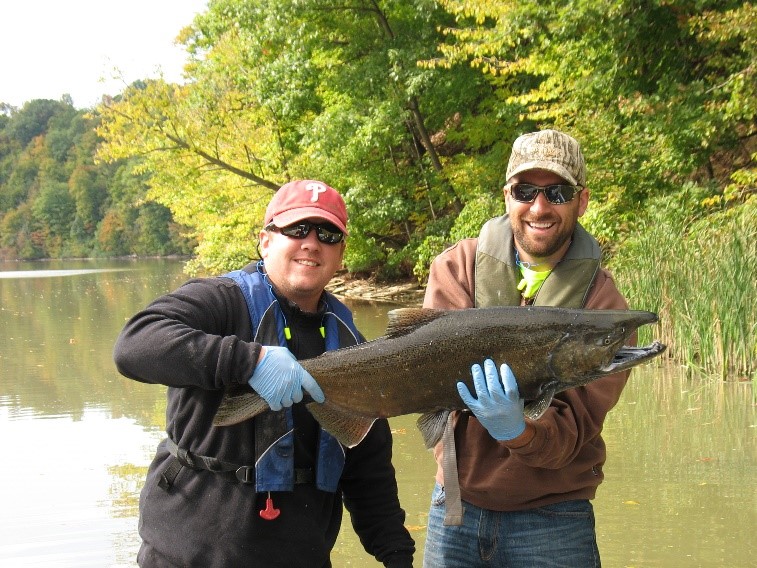
NEW YORK (September 1, 2021) – Today, the Environmental Protection Agency announced that habitat for mink and bottom-dwelling aquatic plants and animals has improved to the point where the Degradation of Fish and Wildlife Populations Beneficial Use Impairment, or BUI, can be removed from in the Rochester Embayment Area of Concern. The area of concern is a 35-square mile portion of Lake Ontario. After years of work, including remediation and safeguard efforts, environmental monitoring shows that the removal criteria set by the State of New York has been met.                                                                                                           Chinook salmon captured during a fish community survey Photo Credit: NYS DEC

Research shows that healthy mink now reproduce in Rochester Bay. Another study confirms that the habitat is also healthier for bottom-dwelling animals, plants and organisms. Over the last decade, EPA and its federal, state and local partners have completed several projects to improve the condition of sediment, restore wetlands and improve habitat throughout the AOC.  

“These habitat improvements are important for the many species that depend on Lake Ontario to thrive and Rochester and Monroe County communities committed to seeing better water quality in the lake,” said EPA acting Regional Administrator Walter Mugdan. “Today’s news demonstrates EPA’s commitment to protecting and restoring the Great Lakes, which is only possible with strong partnerships at every level of government and with local communities.”

New York State Department of Environmental Conservation (DEC) Commissioner Basil Seggos said, “Today marks a key milestone in the restoration of the Rochester Embayment and another critical step forward advancing New York’s sustained progress improving Lake Ontario’s water quality and enhancing wildlife habitat. With our local, state, and federal partners, DEC is proud of our work cleaning up sediment and overseeing remediation in the Lower Genesee River that led to this moment, and we are committed to our common goal of restoring Lake Ontario.”

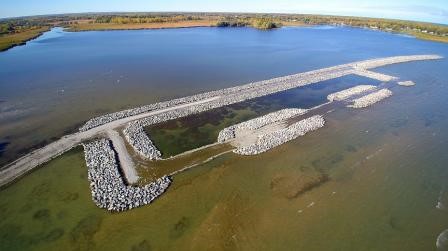
  • Using Great Lakes Restoration Initiative, or GLRI, funding, U.S. Army Corps of Engineers constructed a 1,695-foot barrier island at the mouth of Braddock Bay and restored 340 acres of emergent and submergent marsh areas.
  •  
  • https://us.vocuspr.com/Publish/518041/vcsPRAsset_518041_119707_457c724b-f42a-4991-ac83-041915127f17_0.jpg
  • Habitat restoration work at Braddock Bay, New York. Photo Credit: U.S. Fish and Wildlife Service
  • Using GLRI funding, U.S. Fish and Wildlife Service created 15.4 acres of pothole habitat and 16 acres of habitat mounds in the confluence of West and Salmon creeks, Lower Salmon Creek, Long Pond West, Buck Pond East and the north portion of Braddock Bay. In addition, 65 acres of wetland were restored or enhanced, and 1,800 linear feet of open water channels were restored.
  • Using GLRI funding, Ducks Unlimited restored 175 acres of coastal marsh habitat, 40 acres of sedge meadow and seven acres of fish spawning pools at Buck Pond, Buttonwood Creek and Salmon Creek. Hydrological connectivity between these waterbodies and Lake Ontario was also restored
  • New York State Department of Environmental Conservation dredged approximately 29,000 cubic yards of contaminated sediment from the Lower Genesee River and then capped the two dredged areas at Eastman-Kodak Business Park in Rochester.

https://us.vocuspr.com/Publish/518041/vcsPRAsset_518041_119708_406777c5-042e-4b61-9a48-ed802871f4ff_0.jpg

Mink at the Rochester Embayment AOC Photo Credit: Brady Dilllsworth, NYS DEC

EPA, the State of New York and many partners are committed to restoring and protecting the Great Lakes as work continues to address three remaining BUIs in Rochester Bay:  

  • Degradation of Aesthetics
  • Loss of Fish and Wildlife Habitat
  • Bird and Animal Deformities or Reproductive Problems

Launched in 2010, the GLRI is a results-driven program to protect and enhance the largest system of fresh surface water in the world. EPA and its partners have now removed 102 BUIs from AOCs in the U.S.

For more information see the Rochester Embayment AOC Degradation of Fish and Wildlife Populations BUI Removal Report, April 2021

Follow EPA Region 2 on Twitter at http://twitter.com/eparegion2 and visit our Facebook page, http://facebook.com/eparegion2


21-055                                                   ###