Search This Blog

Tuesday, April 12, 2016

Native American Students Mentored by Forest Service Scientists

From the USDA:


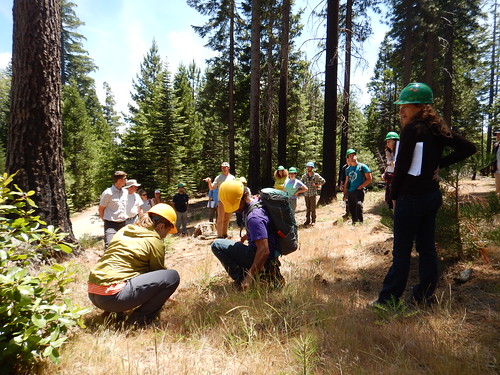
Researchers at the Forest Service’s Pacific Southwest Research Station hosting a two-day field workshop
Researchers at the Forest Service’s Pacific Southwest Research Station hosted a two-day field workshop at the Blodgett Experimental Forest in California as part of last year’s Native American Research Assistantship Program. Photo credit: Jonathan Long, US Forest Service.
The U.S. Forest Service is working with The Wildlife Society to give Native American students a chance to work as research assistants for Forest Service scientists. Forest Service Research and Development funding provides stipends for living expenses for college juniors, seniors and graduate students during their mentorship, while the society provides administrative support and coordination.
The Research Assistantship Program selects Native American students who are interested in becoming wildlife biologists. They gain beneficial hands-on experience while working with a wildlife professional on an approved project. Five students have been selected for research assistantships in this second year of the program, which will last for approximately 12-14 weeks, beginning in late spring and running through late summer.
Bryan Begay, a student at Northern Arizona University, will be mentored by Deahn Donner, a project leader and landscape ecologist at the Forest Service’s Northern Research Station. Their project topic will be “Monitoring bat populations and sharp tail grouse habitat during a barrens ecosystem restoration.”
Elisha Flores, a student at UC Berkeley, and Chase Voirin, a graduate student at the University of Arizona, will be mentored by Serra Hoagland, a biological scientist at the Forest Service’s Eastern Forest Environmental Threat Assessment Center. Their project topic will be “Assessment of wildfire risk in treated and untreated Mexican spotted owl (Strix occidentalis lucida) territories on Tribal lands.”
La’akea Low, a student at the University of Hawai’i – Maui College, will be mentored by Richard Mackenzie, an aquatic ecologist at the Forest Service’s Pacific Southwest Research Station. Their project topic will be “Climate change impacts on recruitment/dispersal of native Hawaiian stream fauna.”
Paden Alexander, a student at the University of Montana, will be mentored by Mike Schwartz, Director at the Forest Service’s National Genomics Center for Wildlife and Fish Conservation. Their project topic will be “Combining Cutting-Edge Genetic Technology and Traditional Ecological Knowledge to Assess and Monitor Wolverine Distribution on the Flathead Indian Reservation.”
“Wildlife are not just names on lists of taxonomic classifications. They are our relatives with whom we live and from whom we learn. Students from Tribal communities are born into that way of thinking and are enriched by those relationships,” said Fred Clark, Director of the Office of Tribal Relations at the Forest Service. “My hope is that our educational system allows for indigenous perspectives to blossom and that future biological scientists approach their work with the most intense intelligence and the most reverent demeanor. We need mind, heart and spirit in biology,” he added.
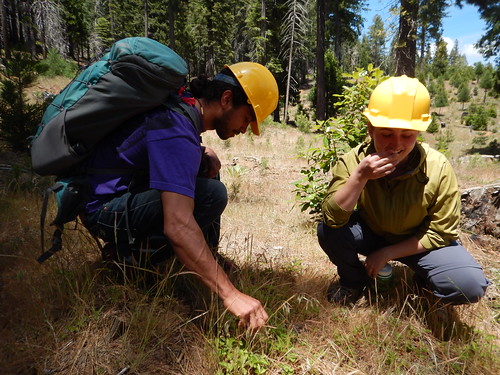
Ray Gutteriez and Jessica Lackey, past Forest Service interns sampling wild strawberries
Ray Gutteriez and Jessica Lackey, who interned with the Forest Service during last year’s Native American Research Assistantship Program, sample some wild strawberries, one of the native plant species Tribal members are seeking to restore. Photo credit: Jonathan Long, US Forest Service.

Saturday, April 9, 2016

Plutonium mess: SC wrangling with DOE over nuclear waste facility, Russia grows angry

Despite concessions from the Department of Energy, South Carolina has no intention of dropping its lawsuit against the DOE for failing to build a nuclear waste disposal plant. The delay is also scuppering a deal the US made to treat Russia’s plutonium.

https://www.rt.com/usa/338987-plutonium-mox-carolina-putin/

Friday, April 8, 2016

New Beginnings Spring from the Homeless Garden Project

From the #USDA:


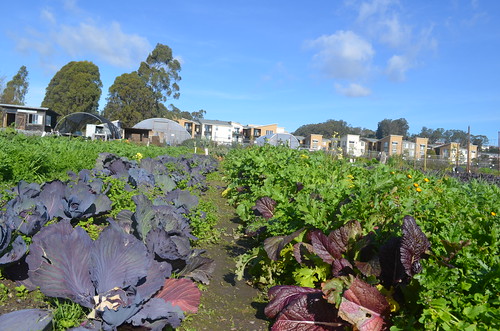
Field crops on the Homeless Garden Project
Field crops on the Homeless Garden Project. NRCS photo.
The Homeless Garden Project (HGP) in Santa Cruz, California provides sanctuary, refuge and meaningful work for homeless citizens within the healing environment of a three-acre organic farm in Santa Cruz, California. This unique urban garden and farm is inspired by the joy that comes from growing and sharing healthy food, the well-being created by vibrant social and natural ecosystems, and every individual’s potential for growth and renewal.
HGP Director Darrie Ganzhorn said, “Our vision is to create a thriving and inclusive community, workforce and local food system. Our goal is to create a world-class farm.”
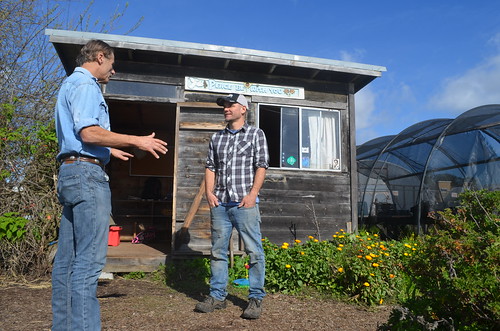
Farm Manager Chris Omer gave me a tour of the garden, along with USDA NRCS District Conservationist Rich Casale and NRCS Earth Team Volunteer and University of California (UC) Santa Cruz student Ryan Hutchison.
Rich Casale, NRCS district conservationist, providing assistance to Chris Omer, farm manager, Homeless Garden Project
Rich Casale, NRCS district conservationist, provides assistance to Chris Omer, farm manager, Homeless Garden Project, Santa Cruz, CA. NRCS photo.
HGP runs a Community Supported Agriculture (CSA) program, and trainees create value-added products, such as such as wreaths and candles, from farm-grown materials that are sold at a retail store downtown. People who are homeless can become trainees in the garden, where they gain transitional employment, learn basic life skills, share four hot meals a week with staff and others, and grow organic food for the local community. HGP’s Value-Added Enterprise provides work opportunities for trainees all year long, particularly during the rainy season.
Next year, the Homeless Garden Project will be growing even more as it moves to a 614-acre city-owned greenbelt site that includes a nine-acre permanent farm site. NRCS staff have been assisting with the site’s conservation plan and other natural resource issues.
“Having a permanent site provides new opportunities—for the first time, we’ll be able to have orchards and create a 20-year farm plan,” said Ganzhorn.
The USDA Natural Resources Conservation Service (NRCS) provides conservation assistance for all types of agriculture–from the very large-scale production farm and ranch to small, community-based projects such as this.
Omer said, “Early on, we met with [NRCS district conservationist] Rich Casale to talk about the possibility of using the NRCS Environmental Quality Incentives Program Organic Initiative and conservation planning for the site.”
NRCS provided soils information and preliminary wetland determinations for the new site, as well as overall conservation planning assistance. “The goal is to incorporate wildlife and enhance any wetland areas, organically working with nature,” said Casale. “There are major opportunities with the new site. You want to think of water issues up front and plan for key strategies such as water harvesting and irrigation. Understanding soil and crops can help make the water go further.”
“You’ve got to keep asking the question―how can we do all of this better?” said Casale.
The farm will be organic from day one. The usual three-year period to transition to organic won’t be needed, since the land has been fallow for years.
Ganzhorn said, “From the very beginning, Homeless Garden Project has been organic. When addressing root causes of homelessness, it’s always been important to us to use sustainable farming methods and to focus on long-term health and well-being in the most holistic way possible. Organic does this.​”
“The garden engages citizens directly on the importance of organic practices and opens participants’ eyes to possibilities for building a healthier future. Support of community gardens from USDA and NRCS brings national movements together with local citizen action to multiply results of both movements,” she said.
Both NRCS and the Homeless Garden Project benefit immensely from volunteer support.
“Last year, nearly 2,500 people volunteered in our organization, taking away experiences of organic agriculture, community building, social enterprise and a deeper understanding of how our community can address homelessness. Above all, volunteers and visitors take away a sense of agency. We all can build the kind of community we want to live in,” said Darrie.
The NRCS Santa Cruz district office regularly has NRCS Earth Team volunteers, many of whom are students at UC Santa Cruz. These Earth Team volunteers work on anything from conservation planning to soil testing. Many former Earth Team volunteers from this office have gone on to careers in agriculture and environmental fields. In addition to experience, the time as an Earth Team volunteer also provides insight into the types of careers possible for them.
Homeless Garden Project participants have transitioned from being homeless to careers in farming, restaurants, floral shops and others, and to having their own homes. The garden is life-giving in so many ways, and demonstrates that effort, care and patience can make both people and plants thrive.
It is wonderful to see NRCS, working along with so many others, provide assistance to such a worthy effort ―one that enables people, as well as plants, to grow and blossom.
For more information on NRCS, visit our website at www.nrcs.usda.gov; for information on NRCS assistance for organic agriculture, visit www.nrcs.usda.gov/organic.
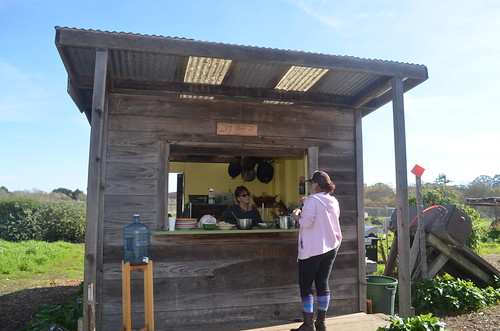
A woman ordering from the Homeless Garden Project kitchen
The Homeless Garden Project kitchen provides meals from food grown in the garden to workers, volunteers, and trainees. NRCS photo.

Deciphering County Estimates Process

From the #USDA:


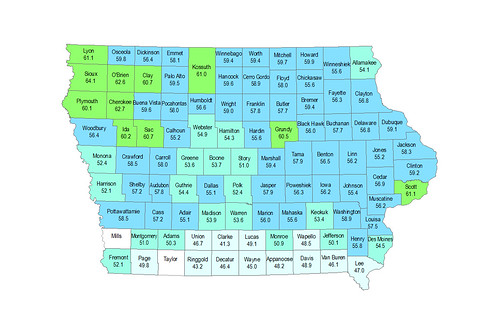
2015 Soybean Yield graphic
2015 Soybean Yield graphic. Click to enlarge.
This post is part of the Science Tuesday feature series on the USDA blog. Check back each week as we showcase stories and news from USDA’s rich science and research portfolio.
Farmers love data. And while big picture items are great, growers tell us they really want and can use local data. In addition to national and state-level statistics, some of our most popular data are the county-level agricultural production information that we collect and publish.
Collecting local data is not an easy task. For example, in Iowa, where I oversee agricultural statistics, to determine 2015 county-level numbers, we surveyed 11,500 farmers in December and January to supplement data from nearly 3,000 Iowa farmers surveyed for the January 12th Crop Production Annual Summary report. These statistical surveys are designed so all farmers in the state have a chance to be selected for participation. In order to publish county data, we need responses from at least 30 producers in each county or yield reports for at least 25 percent of the harvested acreage in a county. Luckily, here in Iowa, we received 50 or more farmer reports for many counties but we still had a couple of counties that did not make the 30 report requirement for publication.
In addition to farmer-reported acreage and yield data, NASS uses aggregated certified acreage data from USDA’s Farm Service Agency (FSA), insured acreage data from USDA’s Risk Management Agency (RMA), and the NASS satellite-based acreage data (cropland data layer) to help determine planted and harvested acreage for each county.
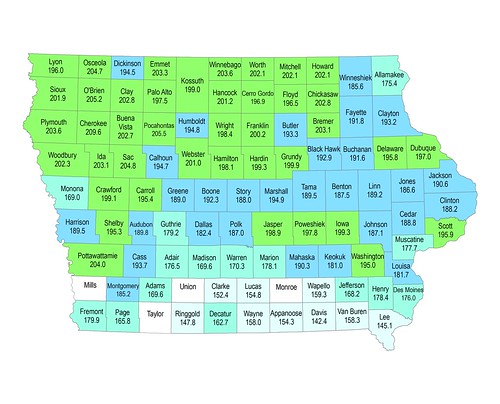
The latest county data in Iowa is pretty exciting. More than one-half of our 99 counties had record high corn yields in 2015 with average yields in 22 counties surpassing 200 bushels per acre. Four of the five highest yielding counties were in the northwest crop reporting district with Cherokee leading all counties, at 209.6 bushels per acre. Just over half of the counties also saw record high soybean yields in 2015 and 11 counties averaged more than 60 bushels per acre, led by Sioux County at 64.1 bushels per acre. Cherokee (62.7), O’Brien (62.6), Lyon (61.1), and Scott (61.1) counties rounded out the top five. Yields of less than 50 bushels per acre were recorded in 12 southern Iowa counties.
The importance of responding to NASS surveys cannot be overstated. The estimates resulting from the surveys do more than just settle arguments about which county had the highest or lowest average yield. Under the 2014 Farm Bill, FSA uses the NASS county yield data to calculate Agriculture Risk Coverage – County (ARC-CO) benchmark revenues and crop year county revenues. If the actual county crop revenue falls below the ARC-CO guaranteed revenue for a given year, an ARC-CO payment is triggered for that crop/county. So, the NASS county yield, along with the crop’s U.S. marketing year average price, are used to help determine payments for this program.
These data also help provide the T-yields farmers use for insurance purposes when actual yields are not available. They also provide the data needed to make the trend-adjusted yield endorsement available which allows producers to increase their insurance coverage. County estimates assist in determining payments for group risk insurance policies and Farm Service Agency county loan rates for the marketing loan program. County data also contribute to administering disaster assistance and conservation programs.
I encourage you to check out our county numbers for yourself. The complete report from NASS showing county-level corn and soybean acreage, yield, and production numbers for Iowa counties is available at www.nass.usda.gov/Statistics_by_State/Iowa/Publications/. Or access the data for any state or county from the NASS Quick Stats database at quickstats.nass.usda.gov.
2015 Corn for Grain Yield graphic
2015 Corn for Grain Yield graphic. Click to enlarge.

Thursday, April 7, 2016

Deutsche wollen Pfand auf Kaffeekapseln

Kaffee aus kleinen, bunten Döschen ist vielleicht praktisch, aber nicht gerade umweltfreundlich. Eine Umfrage hat ergeben, dass die Mehrheit der Deutschen ein Pfandsystem befürwortet. Nicht jedem Hersteller schmeckt das.

http://www.dw.com/de/deutsche-wollen-pfand-auf-kaffeekapseln/a-19170524

Tuesday, April 5, 2016

NREL Reveals Potential for Capturing Waste Heat via Nanotubes

From NREL:


NREL Reveals Potential for Capturing Waste Heat via Nanotubes

APRIL 04, 2016
A finely tuned carbon nanotube thin film has the potential to act as a thermoelectric power generator that captures and uses waste heat, according to researchers at the Energy Department's National Renewable Energy Laboratory (NREL).
The research could help guide the manufacture of thermoelectric devices based on either single-walled carbon nanotube (SWCNT) films or composites containing these nanotubes. Because more than half of the energy consumed worldwide is rejected primarily as waste heat, the idea of thermoelectric power generation is emerging as an important part of renewable energy and energy-efficiency portfolios.
"There have not been many examples where people have really looked at the intrinsic thermoelectric properties of carbon nanotubes and that's what we feel this paper does," said Andrew Ferguson, a research scientist in NREL's Chemical and Materials Science Center and co-lead author of the paper with Jeffrey Blackburn.
The research, "Tailored Semiconducting Carbon Nanotube Networks with Enhanced Thermoelectric Properties," appears in the journal Nature Energy, and is a collaboration between NREL, Professor Yong-Hyun Kim's group at the Korea Advanced Institute of Science and Technology, and Professor Barry Zink's group at the University of Denver. The other authors from NREL are Azure Avery (now an assistant professor at Metropolitan State University of Denver), Ben Zhou, Elisa Miller, Rachelle Ihly, Kevin Mistry, and Sarah Guillot.
Nanostructured inorganic semiconductors have demonstrated promise for improving the performance of thermoelectric devices. Inorganic materials can run into problems when the semiconductor needs to be lightweight, flexible, or irregularly shaped because they are often heavy and lack the required flexibility. Carbon nanotubes, which are organic, are lighter and more flexible.
How useful a particular SWCNT is for thermoelectrics, however, depends on whether the nanotube is metallic or a semiconductor, both of which are produced simultaneously in SWCNT syntheses. A metallic nanotube would harm devices such as a thermoelectric generator, whereas a semiconductor nanotube actually enhances performance. Furthermore, as with most optical and electrical devices, the electrical band gap of the semiconducting SWCNT should affect the thermoelectric performance as well.
Fortunately, Blackburn, a senior scientist and manager of NREL's Spectroscopy and Photoscience group, has developed an expertise at separating semiconducting nanotubes from metallic ones and his methods were critical to the research, Ferguson said.
"We are at a distinct advantage here that we can actually use that to probe the fundamental properties of the nanotubes," he said.
To generate highly enriched semiconducting samples, the researchers extracted nanotubes from polydisperse soot using polyfluorene-based polymers. The semiconducting SWCNTs were prepared on a glass substrate to create a film, which was then soaked in a solution of oxidant, triethyloxonium hexachloroantimonate (OA), a process known as "doping." Doping increases the density of charge carriers, which flow through the film to conduct electricity. The researchers found the samples that performed the best were exposed to a higher concentration of OA, but not at the highest doping levels. They also discovered an optimum diameter for a carbon nanotube to achieve the best thermoelectric performance.
When it comes to thermoelectric materials, a trade-off exists between thermopower (the voltage obtained when subjecting a material to a temperature gradient) and electrical conductivity because thermopower decreases with increasing conductivity. The researchers discovered, however, that with carbon nanotubes you can retain large thermopowers even at very high electrical conductivities. Furthermore, the researchers found that their doping strategy, while dramatically increasing the electrical conductivity, actually decreased the thermal conductivity. This unexpected result is another benefit of carbon nanotubes for thermoelectric power generation, since the best thermoelectric materials must have high electrical conductivity and thermopower, while maintaining low thermal conductivity.
The investigation conducted by the NREL researchers was funded by a grant from its Laboratory Directed Research and Development program, while the development of the semiconducting SWCNT separations was funded by the Solar Photochemistry Program within the Energy Department's Office of Basic Energy Sciences.
NREL is the U.S. Department of Energy's primary national laboratory for renewable energy and energy efficiency research and development. NREL is operated for the Energy Department by The Alliance for Sustainable Energy, LLC.
###

Green Infrastructure Reduces Pollution

From NOAA Digital Coast:


Add some #GreenInfrastructure to reduce impact of land-based pollution to #corals http://1.usa.gov/1UdmQ5j