Search This Blog

Thursday, October 1, 2015

In Conversation with #WomeninAg: Anita Adalja

From the #USDA:


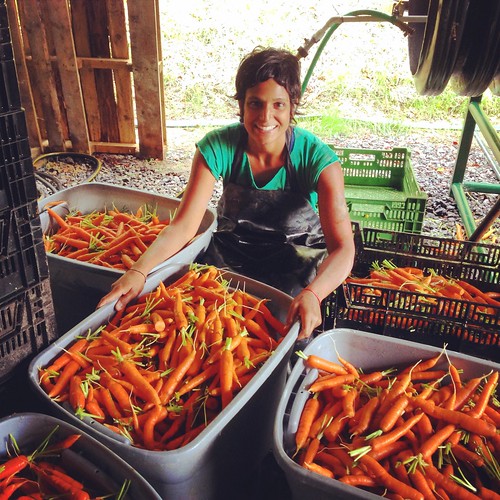
Anita Adalja with carrots
Anita Adalja, a social worker by training, merged her career with farming to help her local community come up with healthy food access solutions.
Today in our Women’s Week blog series, we speak with Anita Adalja, the Farm Manager at Arcadia Center for Sustainable Food and Agriculture. A social worker who merged her career with farming, Anita is committed to food access solutions, community building and sustainable land stewardship.
Arcadia is a nonprofit organization dedicated to creating a more equitable and sustainable local food system in the Washington, DC area.
How do you start your day?
I typically start my day by feeding Dandelion, our farm cat, who meets me at my truck as I drive in each morning. From there I walk around the site with my coffee mug in hand, checking on crops and creating the task list for the day. As a non-profit educational farm, we open our fields each day for volunteers to come work alongside us and learn as they weed and harvest, so shortly after I arrive each morning I’m joined by eager individuals wanting to soak up as much as they can about growing. 
What inspired you to pursue a career in agriculture?
Before being called to farming, I was a social worker in Brooklyn, NY. While I was working with formerly homeless, mentally ill adults in a supportive housing facility, I co-founded a rooftop farm on top of the building. The transformation in my own work – alongside improvements in the health and well-being with both staff and residents – was tremendous. My commitment to food access, food justice and community building was solidified through this experience. From there, I threw myself into farming by attending an apprenticeship program at the Center for Agroecology and Sustainable Food Systems in Santa Cruz, CA.  I haven’t looked back since. 
What is your favorite part of your job?
I have many favorites to my job – I consider myself to be very lucky! The best aspect of my job is the role Arcadia is playing in increasing food access in the DC-area. Our produce is going out into communities where people have little to no access to fresh produce, and our Mobile Markets are making a huge impact.  On a challenging 95 degree day in the middle of summer, knowing that these vegetables are going to folks who need and appreciate them and into communities that have been intentionally ignored for political, racial and socio-economic reasons motivates me to grow more, and to grow better. 
Who are your role models in agriculture ?
Margaret Schlass, of One Woman Farm, is my biggest role model in agriculture. I had the privilege of working for her in western Pennsylvania last season, and she is truly an artist. The fields are Margaret’s canvas, where she paints with total dedication to the craft, endless positivity, and with both awe and gratitude to the earth. She is unapologetic in her strength and confidence, and she has earned her place among the great farmers in this country. 
What do you wish you knew when you were first getting started in agriculture?
I wish I knew and appreciated that every mistake is an opportunity to make changes the next season. 
What are you watching, reading or listening to?
I browse through cookbooks during the growing season, looking at all the delicious things that I am going to cook when I have the time in the winter! And as for what’s playing in my truck, lately it’s been a balance of NPR, Langhorne Slim’s latest album, and a “Learn Spanish” podcast. 
In seven words or less, what is some advice you would offer your fellow women in agriculture?
Don’t ask questions when you already know.
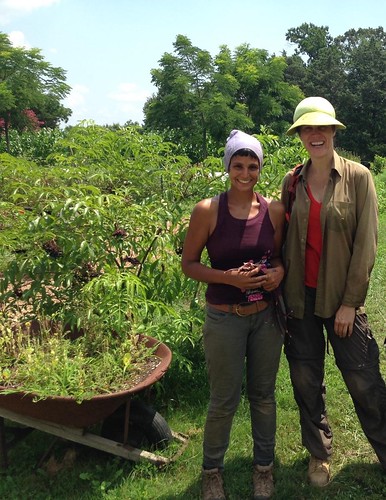
Anita Adalja, the Farm Manager at Arcadia Center for Sustainable Food and Agriculture
Anita Adalja is the Farm Manager at Arcadia Center for Sustainable Food and Agriculture.
    

‘This Is a Shock’: Scientists Put Mealworms on a Diet of Styrofoam and Were Surprised to See What Happened | TheBlaze.com

Fifty years — that’s about how long it takes a plastic foam cup to decompose naturally in the environment.
New research though suggests that a tiny animal could do the work much faster, providing the first evidence that bacteria inside mealworm guts can degrade plastic materials.


‘This Is a Shock’: Scientists Put Mealworms on a Diet of Styrofoam and Were Surprised to See What Happened | TheBlaze.com

Black-crowned Night-herons

From the USFWS National Wildlife Refuge System:


Near the boardwalk at Bosque del Apache National Wildlife Refuge in New Mexico, black-crowned night-herons are stealing the show. Watch for some of the first returned northern pintails, ruddy ducks and gadwalls in supporting roles with cameos by American white pelicans. Photo: John Olson. Thanks, Bosque!

Mountain Bluebirds

From the U.S. Fish and Wildlife Service, Mountain-Prairie Region:


Mountain bluebirds migrate through Seedskadee#WildlifeRefuge in large numbers during spring and fall migration. Many stay to nest as well. These two were some of the first spotted during last year's spring migration. 

Photo: Tom Koerner / #USFWS

Community Unites to Help At-Risk New England Cottontail

From the #USDA:


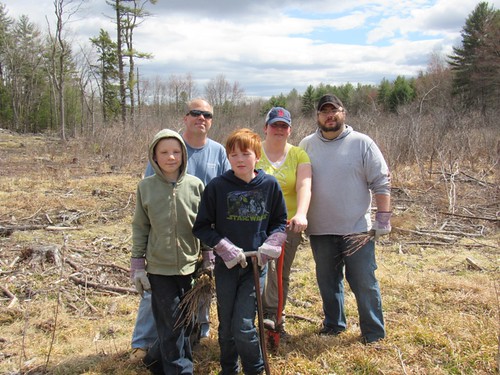
Local boy scout troop members and their families posing with bundles of shrubs and planting bars
Local boy scout troop members and their families pose with bundles of shrubs and planting bars at the edge of a wetland where they are planting shrubs for New England cottontail habitat. Photo by Phillip Brown, Audubon.
A New Hampshire community came together to help restore habitat for the New England cottontail, a native rabbit of the region. For this rabbit, habitat restoration is pretty simple, planting the shrubs that are the cornerstones of its ideal habitat.
Nearly 40 volunteers gathered in April to plant more than 5,000 shrubs at Smith Sisters Wildlife Sanctuary, a 115-acre sanctuary managed by Audubon. Volunteers planted 10 different shrub species, including elderberry, dogwoods, Virginia rose, American hazelnut, fragrant sumac, eastern red-cedar, nannyberry and arrowwood viburnum.
The shrubs, funded through a Farm Bill conservation program offered by USDA’s Natural Resources Conservation Service (NRCS), were planted in a timbered area, converting it into a thicket of native shrubs.
“I was thrilled to see the amount of community volunteers who came out to create habitat for this state endangered species,” NRCS Soil Conservationist Matthew Larkin said.
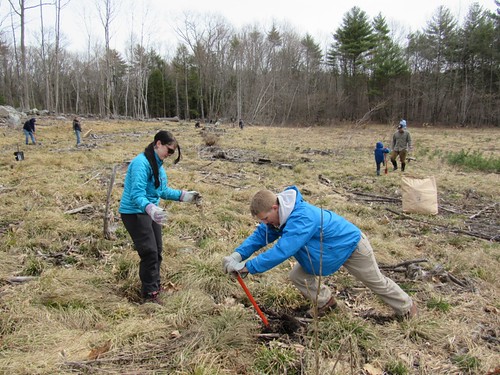
A team of two volunteers digging a hole and preparing to plant a native bare-root shrub
A team of two volunteers dig a hole and prepares to plant a native bare-root shrub in an old field setting on a NH Audubon wildlife sanctuary. Photo by Phillip Brown, Audubon
Groups were divided into morning and afternoon shifts, working to get the native shrubs in the ground to help restore thicket habitat needed for the New England cottontail’s survival and for more than 100 wildlife species sharing similar habitat needs, including the American woodcock, blue-winged warbler, whitetail deer and rough grouse.
The primary threat to the rabbit is habitat loss when forests mature, and the region’s only native rabbit has suffered critical population declines over time. This restoration effort is one of many underway to help the rabbit.
Earlier this month, the U.S. Fish and Wildlife Service determined listing under the Endangered Species Act was not necessary for the rabbit. This effort – plus the many more occurring across the region – are helping the species rebound. 
The Stewardship Network: New England helped to gather community volunteers, who worked very hard. “We are so fortunate to support these partners and volunteers who came together to help this important effort to grow the numbers of New England cottontails,” NRCS Acting State Conservationist Jade Nield said. “I couldn’t be more proud of what they’ve accomplished.” 
Shrubs are fairly easy to plant using shovels, planting bars and a little muscle to open the soil surface to create space for bare roots to naturally set in, plant the shrub and backfill with soil dug from the hole, lightly compacting the soil around the stem and leaving the rest to nature.
Since 2012, NRCS has worked with FWS through the Working Lands for Wildlife partnership to provide financial and technical help to private landowners who voluntarily apply conservation practices to their land, as well as provide regulatory predictability under ESA. Since 2012, more than 5,200 acres of habitat have been restored in the six-state region, including nearly 1,000 acres in New Hampshire.
Efforts to restore thicket habitat for the New England cottontail builds on the historic success of voluntary conservation practices on private lands that benefit wildlife while supporting working lands. Recently, because of proactive steps by private landowners to restore and improve habitat, listing was not required for the greater sage-grouse, the Bi-State sage-grouse or the Arctic grayling and the Oregon chub was delisted.
Learn more about NRCS’ wildlife conservation efforts. To get started with NRCS, visit your local USDA Service Center or www.nrcs.usda.gov/GetStarted.
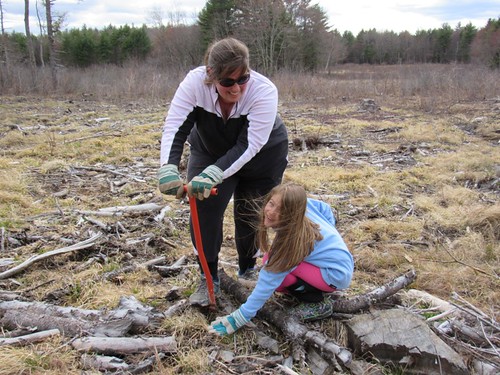
A mother and daughter duo enjoying the task of planting hundreds of bare-root native shrubs
A mother and daughter duo are enjoying the task of planting hundreds of bare-root native shrubs for New England cottontail habitat on a NH Audubon wildlife sanctuary in Newmarket. Photo by Phillip Brown, Audubon.
    

A New Online Tool to Help Growers Select the Right Cover Crop

From the #USDA:


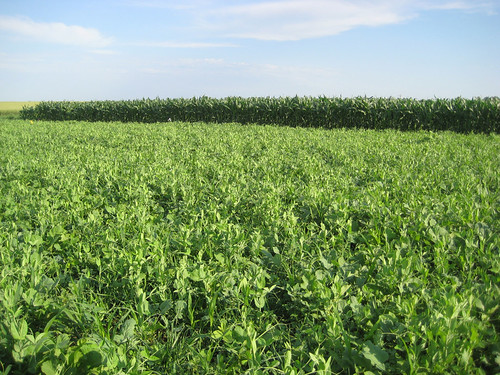
A cover crop mixture
A cover crop mixture that includes oat, proso millet, canola, sunflower, dry pea, soybean and pasja turnip. Photo by Mark Liebig, ARS.
This post is part of the Science Tuesday feature series on the USDA blog. Check back each week as we showcase stories and news from USDA’s rich science and research portfolio.
Whether you’re a home gardener or a commercial grower of vegetables, cotton, or other agricultural crops, as soon as the growing season is over, you may want to consider planting cover crops—grasses, legumes and small grains that protect and improve the soil.
Cover crops, which are typically grown off season, help reduce soil erosion, increase organic matter and control weeds. At the same time, they can lessen the effects of extreme weather conditions such as drought and help improve water and air quality as well as wildlife habitat.
But how do you know which cover crops are right for you? Although a lot of information is available about individual cover crops, there’s a need to show how these crops could potentially complement one another when grown together.
An online tool developed by USDA’s Agricultural Research Service (ARS) scientists is a good place to start.
Soil scientist Mark Liebig and his colleagues at ARS’s Northern Great Plains Research Laboratory in Mandan, North Dakota, have developed the “Cover Crop Chart” to provide information on suitable crops to help you meet your individual production and management goals, big or small.
The new chart is a compendium of information from various sources, including research conducted at Mandan, on more than 50 crop species. This useful visual aid provides a first step for growers to learn about cover crops and how certain cover crops might fit in with others being planted.
Crops are categorized in the chart by similar attributes—cool season or warm season, grasses or broadleaf, and legumes. The chart lists details on growth cycle, water use, plant architecture, forage quality, pollination and more, thereby giving growers an abundance of information to help determine what crops might work best for them.
To download a free copy of the Cover Crop Chart, go to www.ars.usda.gov/pa/ngprl.
    

$7 million settlement with the state advances Duke Energy's efforts to close coal ash basins in ways that protect people and the environment - Duke Energy

$7 million settlement with the state advances Duke Energy's efforts to close coal ash basins in ways that protect people and the environment - Duke Energy