Search This Blog

Wednesday, August 26, 2015

Indiana Bats

From U.S. Fish and Wildlife Service Midwest Region:


Endangered Indiana bats are starting to arrive at their winter homes! Many females will enter the hibernacula shortly, but males will remain active until late autumn.

Photo: Indiana bats by Ann Froschauer/USFWS.

Florida Semaphore Cactus

From the USFWS Southeast Region:


A project is underway to reintroduce Florida Semaphore Cactus to Florida Keys.http://1.usa.gov/1PQxVUn (Photo: Dave Bender, FWS. )

Tuesday, August 25, 2015

Student Climate and Conservation Congress: Bright Young Minds

From the #USDA:


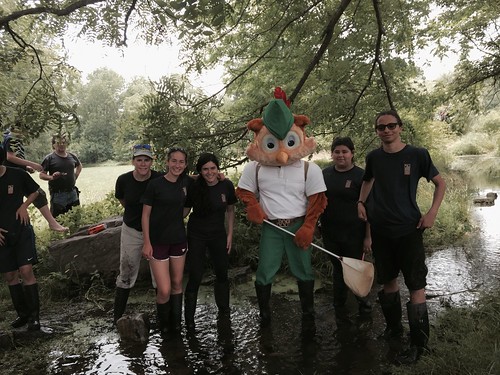
Woodsy Owl with Sc3 students
Woodsy Owl joins Sc3 students in a river ecology conservation adventure.
This year, for the first time, the Forest Service partnered with the Green School Alliance and their principle partner the Fish and Wildlife Service (FWS) in support of the Student Climate and Conservation Congress (Sc3).  Held June 21-27 on the beautiful campus of the FWS’s National Conservation Training Center in Shepherdstown, West Virginia. Sc3 brought together more than 100 creative, innovative and dedicated high school students from across the country.  While there were adults present if needed, Sc3 was a youth driven congress.  Their big quest “To change everything, we need everybody.  How will you engage others in developing a brighter and more just global community?”
For the Forest Service the Sc3 was a great opportunity to look through the eyes of youth as they prepare for their generation’s leadership role in addressing the challenges of a changing climate.  As shared by Dr. Douglas Boyce, Acting Climate Change Advisor, “I was particularly impressed with the students’ depth of knowledge and grasp of issues surrounding climate change.  Dealing daily with the problems associated with climate change, I found hope for the future because I learned these students are engaged, passionate, and poised to help society tackle and solve the mounting number of significant and challenging climate change issues.”
At the beginning of the Congress, students decided on ten topics and were charged to develop a project and presentation around a chosen topic – with the intent to implement their projects when they returned home.  The ten topics were:  education, lifestyle change, justice and policy, community/political, agriculture/food and gardening, social media/technology, sustainable infrastructure, climate change, art and waste management. 
Avoiding the climate change doom and gloom, students were creative and innovative in tackling the topics. Presentations included innovative websites full of information and a call to action, a vertical garden created from recycled products, the “Shake and Fold Challenge” used song and dance in a “video commercial” on how to not waste water or paper – just shake, shake, shake your wet hands and only one paper towel, please.  Woodsy Owl got his groove on in the commercial to show his support of conservation.  Another presentation “Earth without Art is Eh” students cleverly combined humor with science and an artistic flare to present how they see the world in relation to climate change and conservation. For them everything in the natural world is art, including us.
Each of the Sc3 10 topics is a potential concern/impact needing further discussion as we develop local, national and international strategies to meet the climate change and conservation challenges to come.  Several of these students are already involved in Forest Service program partnerships that focus upon conservation education, land stewardship and food security.  In the future, we will likely see some of these Sc3 students join the Forest Service team as leaders in addressing issues and creating solutions to climate change and natural resource conservation.
    

Sandhill Cranes

From the USFWS National Wildlife Refuge System:


Manith Kainckara took this dramatic photo of sandhill cranes at Bosque del Apache National Wildlife Refuge, NM

Plume Moth

From Great River and Clarence Cannon National Wildlife Refuges:


This unique insect, with it's thin body and "T" shape, is called a Plume Moth. Their wings have the appearance of a bird's plume (feathers) and when at rest, the moth rolls both wings into a rod shape. The result is an unusal profile for a moth. When perched, they resemble a vintage propeller airplane.

Monday, August 24, 2015

Little Green Dude

From Archie Carr National Wildlife Refuge:


Here's a close up of our little Green dude. He was enjoying his first view of the morning sun. sunglasses emoticon 

Photo: A. Vazquez/USFWS

Commitment to Innovation and Conservation Shapes the Littles' Family Farm

From the #USDA:


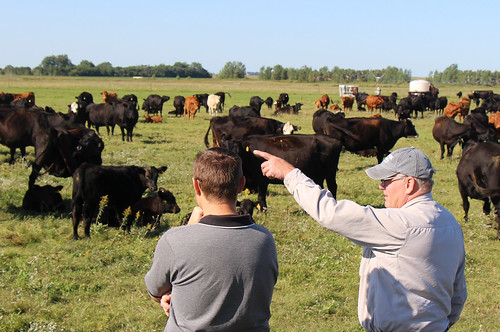
The Littles in front of their cattle
The Littles have a diversified farming and ranching operation. Photo: Dan Zinkand for NRCS.
When you stop on a bridge that crosses the Big Sioux River in Hamlin County, South Dakota, and look south you can see how well Donnie, Barry and Eli Little manage their cows and crops to improve soil and water quality and increase productivity.
Cows graze in one of 24 paddocks that the family manages with a computer program Eli made after graduating from South Dakota State University in 2013. An electric fence along a buffer strip following the river keeps cows out, protecting the source of drinking water for the city of Sioux Falls.
“In 2014, there were ears on every stalk on that field for the first time in years,” says Barry, which he attributes to improved soil and variable rate seed and fertilizer.
The Littles’ farming operation combines brothers Donnie and Barry’s decades of experience with crops and cattle with the talent of Barry’s son Eli’s precision agricultural expertise.
In the early 1990s, the brothers began no-tilling their corn, soybeans and hard red spring wheat. Recently, the Littles have done some strip-tilling of corn.
“With no-till, our soils are like a sponge. There used to be some gullies, but not anymore. A three-inch rain will soak into our no-tilled fields,” said Donnie. “Our fuel and machinery costs are less with no-till. We don’t need a digger or a disk. No-till saves a lot of time.”
“I believe my yields are better with no-till than with tillage,” Donnie said. “We have a moisture deficit, and one to two inches of moisture gained with no-till makes a heck of a difference.
“The Littles are doing a lot of things to make their farm and ranch more productive,” says Jim Dylla, District Conservationist with the USDA’s Natural Resources Conservation Service (NRCS).
For the Littles, multi-species long-season cover crops provide forage for their cow-calf pairs. “We’ve turned most of our hay ground into pasture,” Barry said. “We are working on extending the grazing season as long as we can.”
“Seeding the full-season cover crops is part of our decision to provide more feed for our increased number of cows,” Barry Little says.
“The cows and calves did well on the full-season cover crops in October,” Barry said. “After the calves were weaned in October, they adjusted well in the feedlot.”
In early September, cows had grazed and been moved to another paddock, but some sunflowers, big purple top turnips and radishes still stood as the Littles and Dylla evaluated the post-grazing condition of the soil.
“Getting cover crops planted will do wonders for soil health and soil biology,” Dylla says.
Cover crops do more than provide forage for cows. They also help farmers manage excessive moisture. “We had a lot of rain last fall,” Dylla says. “Any fall moisture is really going to be excessive, so you have to make use of it with cover crops. Instead of the nutrients leaching out of crop ground, the cover crops bring them back up to the surface where they are available for next year’s crop.”
To learn more about NRCS conservation programs and soil health, visit your local USDA Service Center or http://www.nrcs.usda.gov/GetStarted.
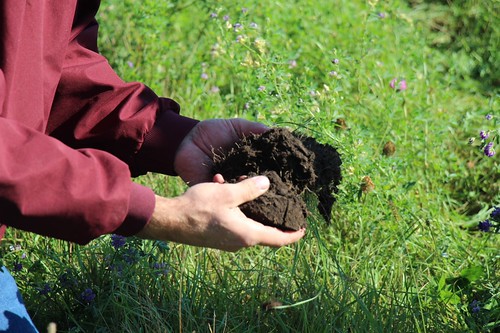
A man holding cover crops
The use of cover crops has become a key element in the Littles' farming and ranching management plan. Photo: Dan Zinkand for NRCS.