Search This Blog

Tuesday, June 2, 2015

All of Georgia's Soils Surveyed and Available Online-Contiguous States Mostly Complete

From the #USDA:


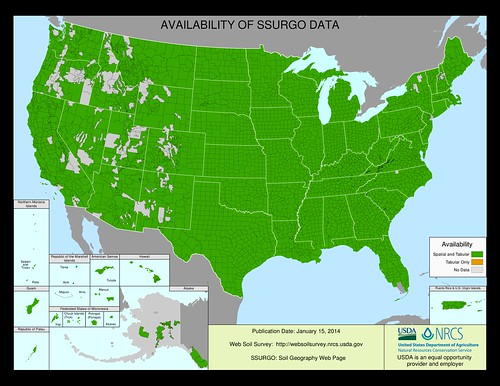
NRCS’ Web Soil Survey Tool map
NRCS’ Web Soil Survey Tool allows agricultural, construction and other industries that rely on soil information to have data at their fingertips.
Soil scientists from across the southeastern region of the U.S. came together recently to celebrate the completion of Georgia’s soil survey. With this mapping complete, very few areas of the nation’s soils in the 48 contiguous states are not recorded.
USDA’s Natural Resources Conservation Service (NRCS) mapped soils information for Georgia’s 159 counties. The map data can be accessed online through NRCS’ Web Soil Survey.
Soil surveys involve studying the nature and properties of soils, mapping their location on the landscape and interpreting their unique sets of characteristics. The information found in these soil surveys was used by producers to better understand their soils, and how best to use and protect them.
“I remember some of my earliest mentors teaching me the importance of why the soil survey was the foundation for our conservation planning. I knew from then on, that this work was creating a vital tool for our conservation toolbox,” said NRCS State Conservationist for Georgia, Terrance O. Rudolph.
Over 200 soil scientists from many different organizations (federal, state, local agencies, as well as private entities and institutions) helped surveyed Georgia’s soils  – work that involved observing, examining, studying, sampling, analyzing, classifying and naming the soils.
The first soil series established in Georgia — named Tifton, Grady, and Chastain — were from the initial soil survey of Grady County, conducted in 1909 by Hugh Hammond Bennett. Bennett, who went on to become the first Chief of what is now known as the NRCS (previously the Soil Conservation Service until 1994), worked on three of Georgia’s earliest soil surveys.
“An understanding of soils, the similarities and differences they exhibit, how they function, and how they respond to management is fundamental to much of the work we do,” said Georgia’s newly retired State Soil Scientist, Steve Lawrence.
While technology has changed the way soil surveys are conducted and used, they continue to contribute to productive agricultural lands across Georgia. The surveys provide critical information to other industries as well.  Engineers in the construction industry consult the surveys for soil related considerations that may affect their projects before building site plans, whether they are residential, commercial or industrial in nature.
Utilization of new technologies will help with the next phase of Georgia soil surveys as we strive to help Georgia’s farmers, timber producers, and other industries become even more efficient and competitive on a global scale.
For more information on the history of Georgia’s soil survey visit: http://tinyurl.com/ofqdtwr.
The United Nations has designated 2015 as the International Year of Soils.
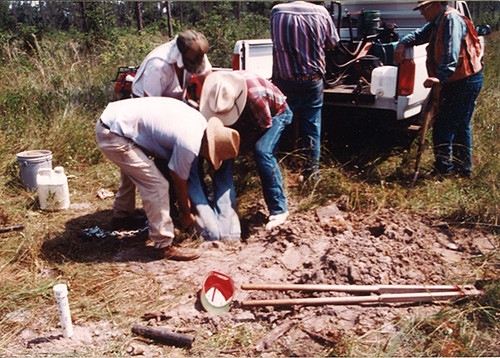
Soil scientists surveying Georgia soils
Soil scientists surveying Georgia soils. Photo: NRCS.
    

Wild Lupine

From U.S. Fish and Wildlife Service Midwest Region:


Wild lupine love the sun and the well-drained, sandy soils of black oak sand savannas. The endangered Karner blue butterfly depends on these beautiful plants for the larvae stages of their lifecycle.

Photo: Lupine field courtesy of Stephen Downes/Creative Commons.

More than 100 Duke Energy volunteers to remove algae from Kings Bay in Citrus County, Fla. - Duke Energy

CRYSTAL RIVER, FLA. -
Thick, greenish-black slime – an algae called Lyngbya – continues to smother native vegetation in Kings Bay, blanketing the springs' sandy bottom and impacting the ecosystem and aquatic wildlife.
For Citrus County's natural springs, the overgrowth of algae is a communitywide problem. For Duke Energy's Elizabeth Pielow, the problem is personal.


More than 100 Duke Energy volunteers to remove algae from Kings Bay in Citrus County, Fla. - Duke Energy

Monday, June 1, 2015

A Dream of Farming Becomes a Reality for this Kentucky Farm Mom

From the #USDA:


Emily Diamond's daughter on the farm
Emily handles the day-to-day operations on the farm, but everyone in the family does their part, which is what makes Diamond Family Farm such a successful family business. Photo courtesy of Emily Diamond, used with permission.
Emily Diamond is a wife, mother, and farmer. She and her family own and operate the Diamond Family Farm in LaGrange, Kentucky. Emily’s farm supplies meat for her family and to the surrounding community through Community Supported Agriculture (CSA). Through CSAs, the community commits to buying the farm’s harvest, sharing both the bounty and risk of farming.
As new farmers, the Diamond family had a dream of producing healthy meat for their family on their own farm.
After hard work and saving their earnings, the family purchased land and began farming. “We built it all from scratch,” Emily said, “but looking back, it would have been easier if we would have purchased land with fencing and a barn already in place.”
 Even with the time and additional money invested to establish fencing, temporary shelters, and purchase livestock, Emily said “there has been a lot of satisfaction seeing something grow from the ground up, becoming more of what you dreamed it would be every year.”
The Diamond Family Farm is home to Sweet Grass Turkey, Freedom Ranger Chickens, meat rabbits, Katahdin Lamb, Jersey/Angus Cows, horses and a variety of other creatures. The variety of animals makes the 16-acre farm operate efficiently. Emily explains, “the more I understand about the animals’ natural role on the farm, the more I am able to utilize their strengths to manage the farm.”
Emily has the knowledge it takes to raise a variety of animals, she spent several years in small and large animal veterinary work after receiving her degree in Animal Science Veterinary Technology. What started as just a way to feed the family healthier meat is now a family business that feeds many people in the local community.
So what is Emily’s advice for others who dream of farming themselves one day? 
She first recommends taking care of the fields – in other words, practice soil health.
Technical assistance from agencies such as USDA’s Natural Resources Conservation Service (NRCS) and programs like the Environmental Quality Incentives Program (EQIP) work to assist land users in accomplishing these goals.  
When farmers like Emily use soil health management systems, they’re improving the soil, the land’s production potential over the long-term and increasing drought resiliency.
Emily’s goal for the family farm is to get back to the basics of good food from happy animals, and she believes raising animals on healthy pastures is the key to reaching that goal. “I let nature take its course by raising the animals in a natural setting for their breed, like allowing cows to care for their calves and only milking them when they are ready to wean the babies,” she said, as rushing production, “eliminates taste and healthy eating.”
Although Emily is in charge of the daily operations of the family farm, from fencing to feeding to hauling, the rest of the family plays have important roles to play as well.  It is truly a family business. After school, the kids help with various chores around the farm. And, Emily explains, “My husband works full time so he’s my weekend warrior, handling all the heavy lifting and tractor work.” Everyone has a job to do on the Diamond Family Farm — even the animals play unique and important roles in its continued success as regenerative agriculture.
To find out more about the importance of healthy soils when it comes to healthy pastures, visit www.ky.nrcs.usda.gov, or contact your local USDA Service Center.
    

Green Salamander

From the U.S. Geological Survey:


Happy Statehood Day Tennessee and Kentucky! — Two statehood days today, but just a few years apart from each other. Today in 1792, Kentucky became the 15th U.S. State. Just 4 years later, on the same day, Tennessee became the 16th U.S. State. Sorry, Tennessee, but your neighbor has a few years on you...that doesn't mean you can pick on each other smile emoticon

In this photo we see a green salamander found in Pickett State Park in Tennessee. Although rare in some parts of their range, they are particularly abundant on cliff habitats in the park.

Thanks to Alan Cressler (alan_cressler on Flickr) for sharing this photo with the USGS Science in Action Flickr Group! Share your earth science photo for a chance to be featured in upcoming USGS products and social media: https://www.flickr.com/groups/usgsscience

#USGS #science #biology #salamander #Tennessee#Kentucky #statehood #USA #history #amphibian

Deadline is Today for Producers to Meet Conservation Compliance Filing Deadline

From the #USDA:


 The U.S. Department of Agriculture (USDA) is reminding producers to file a Highly Erodible Land Conservation and Wetland Conservation Certification form (form AD-1026) with their local USDA Service Center, either by filing in person or postmarking today, June 1, 2015.
The 2014 Farm Bill requires producers to have the form on file in order to remain eligible or to become eligible for federal crop insurance premium subsidies. Many producers already have a certification form on file since it’s required for participation in most USDA programs including marketing assistance loans, farm storage facility loans and disaster assistance.
But producers who only participate in the federal crop insurance program must now file a certification form to receive crop insurance premium support. These producers might include specialty crop farmers who may not participate in other USDA programs.
Form AD-1026 is available at local USDA Service Centers or online. When a farmer completes this form, USDA’s Farm Service Agency and Natural Resources Conservation Service staff will identify any additional actions that may be required for compliance with highly erodible land and wetland provisions. USDA’s Risk Management Agency, through the Federal Crop Insurance Corporation, manages the federal crop insurance program.
USDA has conducted extensive outreach over the past year, especially to producers who only participate in the federal crop insurance program and may be subject to conservation compliance for the first time. Along with the outreach done by crop insurance agents and companies, USDA efforts have included letters, postcards, phone calls, producer meetings and interaction with stakeholder groups to help them reach their members. While there are procedures in place to correct good faith errors and omissions on certification forms, the deadline cannot be waived or extended, and a form must be filed by June 1.
If you have questions about conservation compliance, contact the FSA representative at your local USDA Service Center. USDA has a number of resources available online, including a Five Steps to Meet Conservation Compliance guide and frequently asked questions.
    

Whirlpool Corporation and Kohler Co. Announce Commitment on Research Project for Net-Zero Water in the Home

From Whirlpool Corporation:

June 1, 2015

Whirlpool Corporation and Kohler Co. Announce Commitment on Research Project for Net-Zero Water in the Home

Leaders in home appliance, plumbing industry committed to developing innovative approaches to reducing water consumption

BENTON HARBOR, Mich., June 1, 2015 /PRNewswire/ -- According to recent projections from the Energy Information Agency and USA Today, by 2025 Americans will see their water bills double and potentially triple in major metro areas.  This threat to the wallets of homeowners across the country is adding to speculation that pressure to the U.S. infrastructure, already desperate for solutions to a water shortage in California, is headed toward a significant issue in water access. At this week's Sustainable Brands Conference in San Diego, Whirlpool Corporation and Kohler Co. announced the two companies have committed to identify ways to achieve net-zero water in the home in connection with ReNEWW House, a retrofitted, net-zero energy, water and waste research home located near the Purdue University campus.

Whirlpool Corporation Logo.
Through their products, Whirlpool Corporation, the number one major home appliance manufacturer in the world, and Kohler Co., a global leader in the manufacture of kitchen and bath products, make up nearly all of the indoor water usage in the residential home. During the conference representatives from both companies discussed a shared hope to create energy and water advancements that lead to reduced consumption and allow existing buildings to become self-sustaining systems.

"With 860 million appliances in the United States alone, Whirlpool Corporation has reduced energy and water consumption in our products to deliver efficient home appliances. It's time to look at how we can leverage our appliances to optimize and transform the total home system to try to achieve net-zero water impact," said Ron Voglewede, Global Sustainability Director, Whirlpool Corporation and member of the Alliance for Water Efficiency's Board of Directors. "We are excited to work with Kohler on the ReNEWW House as we look to create new, viable solutions to help new and existing homeowners save water and conserve our most vital natural resource."

"We recognize that to further extend the benefits of water-efficient fixtures and faucets while maintaining optimum performance, we need to look at home water consumption holistically," said Rob Zimmerman, Kohler Sustainability Senior Channel Manager. "We hope that by combining our engineering resources with those of Whirlpool's to understand the technical challenges of creating a 'net zero water' house, we can develop new insights for designing home plumbing, water storage and treatment systems that further reduce water use and better protect our water supplies."

Research into new insights and opportunities for water conservation in the home will be ongoing over the next two years as part of the opportunity with ReNEWW House, a retrofitted, net-zero energy, water and waste research home located near the Purdue University campus.

Both companies share a commitment to sustainability evident through product and process innovation while lowering environmental impact. Whirlpool Corporation created a corporate office for environmental control in 1970, cementing the company's on-going commitment to environmental protection and natural resource efficiency. The company has led the development of new sustainability standards for home appliances, and is the most awarded appliance manufacturer by the Environmental Protection Agency for continued commitment to energy and water efficient products.

Kohler has a long history of supporting water efficiency and sustainability in its products and is aligned with organizations such as the Alliance for Water Efficiency and U.S. Green Building Council. Recognized by the EPA WaterSense® program for excellence and partnership for each of the past seven years, the company has positioned itself as a sustainability leader in the plumbing industry with educational programs, awareness campaigns, and water-saving products.

About Whirlpool Corporation

Whirlpool Corporation (NYSE: WHR) is the number one major appliance manufacturer in the world, with approximately $20 billion in annual sales, 100,000 employees and 70 manufacturing and technology research centers throughout the world in 2014. The company markets Whirlpool, KitchenAid, Maytag, Consul, Brastemp, Amana, Bauknecht, Jenn-Air, Indesit and other major brand names in more than 170 countries. Additional information about the company can be found at

WhirlpoolCorp.com, or find us on Twitter at @WhirlpoolCorp.

About Kohler Co.

Founded in 1873 and headquartered in Kohler, Wis., Kohler Co. is one of America's oldest and largest privately held companies comprised of more than 34,000 associates. With more than 50 manufacturing locations worldwide, Kohler is a global leader in the manufacture of kitchen and bath products; engines and power systems; premier furniture, cabinetry and tile; and owner/operator of two of the world's finest five-star hospitality and golf resort destinations in Kohler and St Andrews, Scotland. Kohler Co. has a long history of supporting water efficiency and sustainability and is a leading producer of water-saving plumbing products, which has earned the company seven consecutive awards from the EPA WaterSense® program. For more details, please visit kohler.com for information on water-saving plumbing products or believe.kohler.com for stories on Kohler's sustainability mission.